Prime Minister Michel Barnier’s downfall has heightened concerns among investors.
By Marc Angrand Published today at 12:50 pm (Paris)
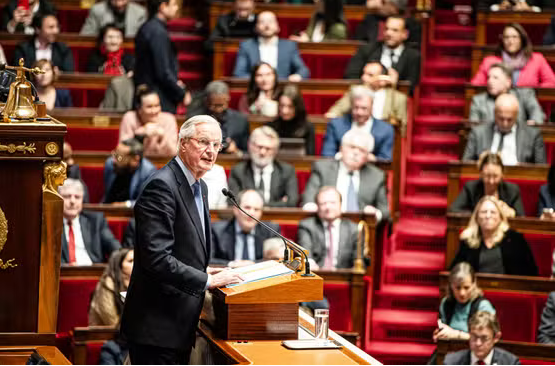
Michel Barnier speaks at the Assemblée Nationale on December 4, 2024. JULIEN MUGUET FOR LE MONDE
Just hours after the vote of no confidence toppled the French government on Wednesday, December 4, Moody’s, which had taken the first step in October towards downgrading its rating, drew the first conclusions: The vote “deepens the country’s political stalemate” and “reduces the probability of a consolidation of public finances.”
You can share an article by clicking on the share icons at the top right of it.
The total or partial reproduction of an article, without the prior written authorization of Le Monde, is strictly forbidden.
For more information, see our Terms and Conditions.
For all authorization requests, contact syndication@lemonde.fr.
For now, the market’s response has been measured. At the start of the day on Thursday, the spread between 10-year French bonds and their German equivalent stood at 0.85 percentage points, compared with around 0.50 points before the June 9 dissolution and a peak of 0.90 points on November 27, the highest since 2012.
“In 2011, when we thought the eurozone might break up, the spread had risen to 200 basis points. We were in real stress. At 80 basis points, we’re under stress, but the lack of visibility is already reflected in the 30-point rise since June,” Bertrand Lamielle, director general of Portzamparc Gestion, said.
‘Well-identified risk’
For the moment, then, there’s nothing to compare with the “serious turbulence” Michel Barnier warned on November 26, even if some analysts are not ruling out a further widening of the spread if the political deadlock continues. Indeed, the last few months have left lasting impressions in the minds of many investors.
“When we talk to American investment funds, the potential political risk in France is well identified. This is not necessarily the case for other countries,” noted Christopher Dembik, senior adviser at private bank Pictet. As for Japanese institutional investors, who had turned away from French debt during the summer, “they still haven’t come back.”
Source: lemonde.fr



 The Tower Post