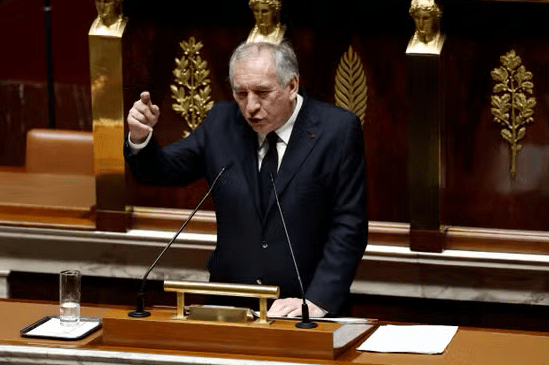
Here’s what Prime Minister François Bayrou said about the contested 2023 pension reform, the budget, and more.
Le Monde with AFP

French Prime Minister François Bayrou, who took office a month ago, presented his priorities to Parliament in his government policy statement on Tuesday, January 14. Like his predecessor Michel Barnier, who lasted just three months before being toppled in a no-confidence vote, Bayrou faces the huge challenge of getting MPs to agree on a long-overdue budget bill for 2025. Here are the key takeaways from his speech in the Assemblée Nationale:
- Pension reform
François Bayrou called for the contested 2023 pension reform that raised the retirement to 64 to be put “back on the agenda,” with a meeting of unions and employers’ federations scheduled for Friday. “The 2023 law planned for the legal retirement age to rise to 63 by the end of 2026. This, therefore, opens up a window of opportunity. I’d like to set a shorter-term deadline, that of autumn (…) We can look for a new path of reform, without any totems or taboos, not even the retirement age,” he added.
- Budget and growth forecasts
In his speech, the prime minister stressed the need to adopt the outstanding 2025 budget without delay, despite the “sword of Damocles of the no-confidence motion” which “seems to have installed precariousness at the top of the state.” With this in mind, he promised “significant savings,” without specifying their nature, and “a powerful movement to reform public action,” with “rethought budgets.”
Bayrou revised France’s 2025 public sector deficit target upwards and cut the forecast for growth in his policy speech. Bayrou said the deficit was now expected to come in at 5.4% of gross domestic product (GDP), up from a previous target of 5%, while economic growth was projected at 0.9% for the year, down from a 1.1% target set by the previous government.
The prime minister also announced that the budgetary effort required of local authorities will not be €5 billion, as had been envisaged by the Barnier government, but €2.2 billion.
- Immigration
“Seeking a form of harmony also means addressing the fears and realities that immigration raises in our country. (…) My deep conviction is that immigration is first and foremost a question of proportion,” said Bayrou. “It is our duty to direct a policy of control, regulation and return to their country of those whose presence, by their number, endangers the cohesion of the nation,” he added.
- Environment
Bayrou said that environmental policy, “contrary to what some people think, is not the problem, it’s the solution, at least the solution we favor.”
- Creating a ‘democracy bank’
The prime minister, in the hope that parties would “be able to finance themselves without the need for workaround strategies,” said he wanted to create “a democracy bank, so that the financing of political parties and campaigns no longer depends on the choices of private banks, but can, eventually, be the responsibility of public bodies placed under the control of Parliament.”
- Electoral system reform
Bayrou proposed moving forward “on the reform of the parliamentary electoral system” with “a proportional principle,” stressing that it should “be rooted in the territories.” This reform “will force us to rethink the question of holding local and national office at the same time,” added the prime minister.
- Creating a special fund dedicated to state reform
The prime minister announced the creation of a special fund “entirely dedicated to the reform of the State,” arguing that the “1,000 agencies and bodies of the state constitute a labyrinth, with which a rigorous country can scarcely be satisfied.” This fund would be financed by assets, “in particular real estate [assets], which belong to public authorities, so as to be able to invest, for example, in the deployment of artificial intelligence in our public services,” he added.
- Resuming study of the ‘Yellow Vest’ grievances
“We’ll have to go back to studying the notebooks of grievances that were presented by the ‘Yellow Vests’,” judged Bayrou, so that “the expectations, often the most unspoken, that are those of social circles excluded from power” might be heard.
- Education
“I think that, in our school and university system, it must be possible to accept and even encourage [career changes], changes in [professional] training,” said the prime minister. He also called for the promotion of reading, at a time when “screens have taken over from any other mechanism for transmitting knowledge.” “This is a national issue,” he stressed.
- Agriculture
Bayrou has pledged to challenge “the pyramids of [regulatory] standards by giving the initiative to users. Those we monitor must have their say on the inspections,” he said, the day after a meeting with the main agricultural unions.
- Housing
Bayrou spoke in favor of “a rethought, large-scale housing policy.” “We can go even further by reducing timeframes, streamlining permit applications, encouraging densification and facilitating usage changes,” he said, adding that “this presupposes boosting rental investment and first home ownership.”
- Health
The government will propose “a significant increase” in the national spending target for the national health insurance service, “which will enable us to improve the working conditions of care providers and protect the most vulnerable,” Bayrou promised. Furthermore, “the measure to [no longer cover] certain drugs and consultations [which was envisaged during budget discussions under the preceding government] will not be taken up again,” he added. The prime minister also promised that wheelchairs would be fully covered “from 2025.”
Corsica
Bayrou promised to “respect” the timetable “to achieve a constitutional evolution” for Corsica “by the end of 2025.” The so-called Beauvau process, which aimed at granting the French Mediterranean island of Corsica greater autonomy, had been initiated in 2022, by then-interior minister Gérald Darmanin at Macron’s request, but the dissolution of the Assemblée Nationale in June 2024 put an end to the discussions. Many of the island’s elected representatives had feared it would be abandoned.
New Caledonia
The prime minister expressed hope that negotiations concerning the French overseas territory would resume and be concluded by the end of the quarter. “In January, I will invite the political forces to come to Paris to open these negotiations, and I will ask the French overseas territories minister to pay particular attention to this issue,” he announced, judging that the Pacific archipelago “must build its future.”
Source: lemonde.fr


 The Tower Post