By Ernest Hoffman

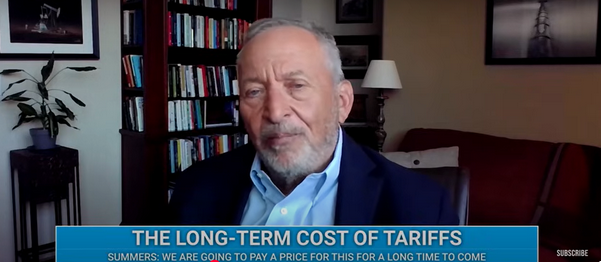
(Kitco News) – Trump’s trade tariffs are the worst economic own-goal in 70 years, and they jeopardize the United States’ ability to sell debt, form security alliances, and conduct economic and foreign policy, according to former U.S. Treasury Secretary Larry Summers.
In an interview with Eurasia Group and GZERO Media founder Ian Bremmer late Tuesday, Summers was asked how disturbing the Trump administration’s trade war was to him, on a scale of one to ten.
“11 or so,” he replied. “This is probably the worst, most consequential, self-inflicted wound in US economic policy since the Second World War.”
Summers said that if the tariffs aren’t imposed, or only remain in place for a brief time, it could contain some of the effects, but much of the damage has already been done.
“If there’s a sense that we’re moving away from an extortionate approach to economic policy, that will calm things down considerably, and that will obviously make the costs of this policy change much lower,” he said. “But I don’t think there’s any chance that we come out of this ahead, and I think even in the best imaginable place, we have lost enormous credibility in the world. We’ve created a large uncertainty premium about what we’re going to do next. And we’re going to be seen as a less reliable country.”
“That affects everything, from our ability to sell the trillions of dollars of debt we need to roll over each year, to our ability to enter into security alliances with countries, to our efforts to win support from countries in international fora,” he added. “This kind of truculence does not go unnoticed, and it is not immediately forgotten, so the issue goes to how much the damage can be contained.”
Asked why he believes President Trump is pursuing trade tariffs on a global scale, Summers said he was at a loss.
“Why does anybody who commits extortion decide that that is the right thing to do?” he said. “I don’t see this as a rational way of either pursuing the objective of strengthening U.S. manufacturing, or the objective of reducing other countries’ trade barriers. If an administration wanted to and was serious about strengthening U.S. manufacturing, the last thing they would do is demolish the CHIPS Act, which was all about creating more manufacturing capacity in semiconductors, perhaps the most sensitive good in today’s global economy. If the objective were to open foreign markets, surely you would negotiate first, and tariff second, not the other way around.”
“So far, the effect of the policies has been to induce retaliation, so that foreign markets are going to be more closed to U.S. producers than before,” he added. “And surely others are going to be more concerned than they would’ve been previously about the uncertainty that’s involved in doing business. There are probably going to be more trade barriers than there were before, not fewer trade barriers.”
Summers also addressed the broader implications of Trump’s trade policies on international cooperation and geopolitical security, saying that the credibility of the presidency and the values of the United States are now in question.
“Even if there are reversals on some specific issues, we are going to pay a price for this,” he said. “Whether it’s who comes to the United States, whether it’s selling debt, whether it’s customers for our companies abroad, whether it’s our ability to rally support, we are going to pay a price for all of this for a long time to come.”
Asked why there has been so little pushback from the leading voices in business and academia who previously championed the U.S.-led globalized system since World War Two, Summers – who also served as the president of Harvard University – said that while individuals are afraid, the collective answer from the market has been clear.
“I think markets have spoken with a particular eloquence and force,” he said. “And every time there’s a twist in this story towards more protection or towards less protection, markets speak again. I think markets have been able to speak with such force because they’re anonymous. No individual is associated with the verdict that they’re rendering. I think for people who lead institutions, they are fearful of retaliation against themselves or against their institution.”
Summers said these leaders may end up regretting their silence, however. “Unless behavior changes, history will record of the United States establishment at this moment that it allowed itself to be especially cowed,” he said. “I think there will be those who could have been influential, who history will judge poorly for their capitulation.”
One potential silver lining that Summers sees is that the extreme economic damage being done by the tariff policy could snap the United States out of its torpor, which may serve to prevent other damaging policies from being enacted.
“I have noticed that this week, after the market calamity, that there are rather more voices who are prepared to be heard,” he said. “I think it could be an irony of the current moment that economic incompetence is going to protect the United States from authoritarian overreach: that precisely because of the magnitude of the economic errors and the disillusionment that has set in, some of the more extreme actions on the part of the administration to basically suspend the rule of law, are going to be more strongly resisted than they otherwise would’ve been.”
Challenged on whether the $10 trillion in lost market cap to date would constitute enough of a crisis to provoke sufficient response, Summers said he could see it going either way.
“We’re not yet in a full-blown financial panic,” he conceded. “On the other hand, there’ve only been three two-day periods in the post-war history of the United States when markets were as weak as they were on Thursday and Friday. My fear is that if there is some respite in markets, the administration will see that as a license to go back and touch the stove again. I would be surprised if markets have put in a bottom for this period, and I suspect there will be more lesson-teaching.”
The final question put to Summers was whether he was more worried about the health of the U.S. and global economy, or the state of American democracy and rule of law.
“Economies move in cycles, economies fluctuate,” he replied. “Even pretty egregious economic policy errors can be reversed, and economies can recover. But the rule of law, traditions of democracy, once those are lost, history teaches that they often are not regained.”
“I believe American institutions will hold,” he concluded, but warned that the thing he’s watching most closely is whether the Trump administration will respect judicial orders. “While there have been judicial judgements with which I disagree, and while the Trump administration has been aggressive in interpreting adverse rulings, I don’t think any fundamental line has yet been crossed with respect to the judiciary as a strong and independent branch of government.”
“I’m enough of an optimist about the United States to believe that it’s likely to hold, but I am far from certain,” he said. “And if it were to not hold, the consequences would be immense.”
Source: Kitco.com