China tariffs will go up to 125 percent while other countries get a 90-day reprieve.
By Eli Stokols, Adam Cancryn, Dasha Burns and Daniel Desrochers
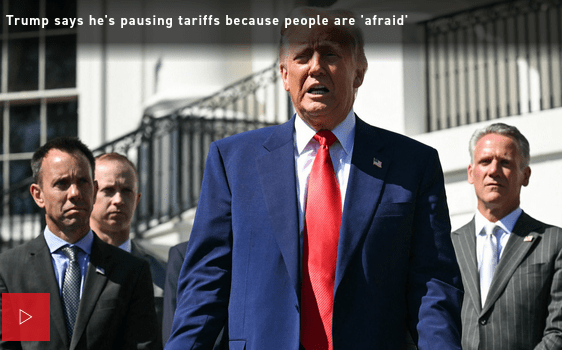
President Donald Trump reversed course in the global trade war he launched just a week ago, announcing in a social media post a 90-day pause on new tariffs against every country but China.
That came just hours after Trump urged the country to “BE COOL” in another post that came amid continued worldwide chaos, with China and the European Union hitting back and the financial fallout spreading to bond markets.
“I think that people were jumping a little bit,” Trump said Wednesday, acknowledging the market turmoil contributed to his decision to back off the tariffs. “They were getting a little bit yippy, a little bit afraid.”
Trump’s off-the-cuff remarks undercut the assertions of aides who’d suggested that all of it was part of a plan, or just “the art of the deal,” and helped make clear that, for all his outward bluster, there is a limit to the amount of political pain the president is willing to absorb.
As he halted his broader tariff program — albeit with a 10 percent “reciprocal” tariff on countries during the pause — Trump ratcheted up tariffs against China to 125 percent. It was based, he wrote, “on the lack of respect that China has shown to the World’s Markets.”
Beijing on Wednesday imposed additional tariffs on imports from the United States for a total of 84 percent, a response to the White House expanding tariffs on all Chinese goods to 104 percent.
But amid the escalating trade fight, Trump insisted that China would eventually join dozens of other nations in seeking a negotiated resolution, vowing to eventually reach trade deals with “all of them.”
“China wants to make a deal — they just don’t know quite how to go about it,” he said. “But they’ll figure it out.”
Trump’s openness to trade talks came just 24 hours after White House press secretary Karoline Leavitt told reporters there were no plans to delay or reverse any of the tariffs.
The walk-back by Trump sent the stock market back into positive territory after several days of huge losses. Treasury Secretary Scott Bessent, who earlier on Wednesday spoke to reporters alongside Leavitt, outlined plans to sit down with his counterparts from Japan, Vietnam and South Korea this week to work on bilateral trade agreements.
“We saw the successful negotiating strategy President Trump implemented a week ago today and it has brought more than 75 countries forward to negotiate,” Bessent said. “It took great courage for him to stay the course until this moment. And what we have ended up with here — as I told everyone a week ago [here] — do not retaliate, and you will be rewarded. So every country in the world who wants to come and negotiate, we are willing to hear you.”
Trump’s inner circle had discussed a 90-day pause, which National Economic Council Director Kevin Hassett teased as a possibility during an appearance on Fox News. But it was anything but locked in until Wednesday, when China’s escalation of tariffs and continued market turmoil led the president and his team to coalesce around the plan, according to a person close to the White House who was granted anonymity to detail internal discussions.
Bessent, the person added, “was critical in feeding into Trump’s instincts of going after China” as a means of finding something of an off-ramp. “He convinced him that going after China is a popular position. Do that and let’s work out a pause on everyone else while we negotiate.”
A Republican lawmaker close to the White House painted a similar picture, telling POLITICO that the 90-day pause “had been in discussion for a week [and] was mostly a matter of whether Trump would pull back one country at a time or all at once.” China’s response, the lawmaker said, effectively settled that question.
Speaking to reporters, Bessent disputed the suggestion that Trump standing down from his trade war, which erased trillions in value from global markets in less than a week, was a recognition of the turmoil he’d created.
“No, President Trump created maximum negotiating leverage for himself,” Bessent said, adding that cementing formal agreements to avoid the reimplementation of tariffs would “take some time.”
Bessent, who flew to Palm Beach last weekend to discuss the spiraling trade war with the president, said that the nation’s financial markets failed to understand that Trump’s tariffs had been a maximal opening salvo in a negotiation.
But Trump later contradicted his Treasury secretary’s contention that the pause was long-planned, saying that he’d been closely watching the market volatility, especially as a sell-off in the bond markets ignited fresh fears about the economy’s stability.
“The bond market is tricky,” Trump said. “I saw last night, where people were getting a little queasy.”
He added that he’d watched JPMorgan Chase CEO Jamie Dimon’s appearance on Fox Business Network earlier in the day, where Dimon told Maria Bartiromo a recession was a “likely outcome” if the trade war continued, and had also met recently with investor Charles Schwab.
Commerce Secretary Howard Lutnick posted on X that he and Bessent were in the Oval Office with Trump as he typed out his post announcing the shift in policy.
And a number of officials and GOP lawmakers in close contact with the White House had gotten a sense it was coming, even if they found out in real time.
Sen. Ted Cruz (R-Texas), who warned Tuesday that a prolonged trade war would be “disastrous,” told reporters Wednesday just before the tariff move was announced that he had been talking with the White House and Trump directly, urging him to back off.
“I am doing everything I can to urge the president to listen to the voices of the angels and not the devils,” Cruz told reporters.
U.S. Trade Representative Jamieson Greer told the House Ways and Means Committee that he knew a pause on the tariffs was under discussion when he entered the hearing Wednesday morning, but that he only learned of the pause in real time.
“I understand it’s 90 days, I haven’t spoken to the president since I’ve been in this hearing,” Greer said.
Greer’s surprise in the hearing “was a tough watch,” said one person close to the Trump White House who was granted anonymity to discuss the situation inside the West Wing. But it made clear that “Scott Bessent is in the driver’s seat now,” this person said, adding that the Treasury secretary, not the USTR, was the leading force behind the president reversing course and would be the point person in trade talks with other countries.
Democrats, who have lambasted the administration for the disruptive policy, were unmoved.
“It looks like your boss just pulled the rug out from under you and paused the tariffs, the taxes on the American people. There is no strategy, you just found out three seconds ago, we saw you,” said Rep. Steven Horsford (D-Nev.).
The dramatic shift from large tariffs to temporary relief is “just a horrible way to run the show. Because you’re demonstrating to people that we’re an unreliable partner,” said Bill Reinsch, who oversaw export policies in the Clinton administration and is now at the Center for Strategic and International Studies. “It’s a roller coaster ride. One day they’re up and one day they’re down. One day they’re on and one day they’re off.”
Until the president’s announcement Wednesday afternoon, neither Trump’s promises of better times ahead nor his aides’ and often contradictory reassurances and rationales had calmed the markets. If anything, they added to the uncertainty that caused trading indexes to spiral out of control and other countries to respond in kind.
Industry CEOs and lobbyists have spent the last few days appealing to anyone who might have direct access to Trump, in an effort to get information in front of the president about the damage that an extended trade war would have on various parts of the economy.
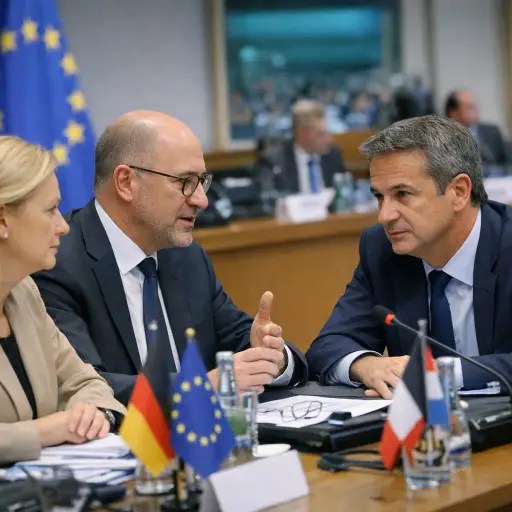
Just as China announced its counter-tariffs, EU member states voted to approve counter-tariffs against the U.S. that would take effect Tuesday, the bloc’s first response to Trump’s tariffs on steel and aluminum from Europe.
Bessent, who asserted that Trump had “goaded” China into retaliating, did not say why Europe’s retaliation wasn’t similarly punished by the White House.
The EU’s retaliatory tariffs will affect nearly €21 billion of U.S. products — everything from soybeans to motorcycles and orange juice — and take effect in three waves.
Yet even as he hit pause, Trump expressed no regret about the tumult he’d created in the week since his self-declared Liberation Day — and left the door open to resuming the trade battle in the near future.
“You have to cut the bone, you have to do what you have to do,” Trump said. “I’m very happy to have done it.”
Source: Politico.com

 The Tower Post