How learning to sew changed my relationship to clothing
By Taylor Moore

Picture this: You’re standing in the apparel section at Target. You came to buy home goods, yet you couldn’t resist the siren call of an $8 T-shirt you saw styled on TikTok. With bargain prices having won the day, you wear it a few times, but it’s quickly forgotten amid other impulse purchases. A few years later, you donate said shirt to Goodwill, feeling unburdened.
The average American purchases 68 items of clothing per year—five times more than in 1980—owing in large part to the US garment industry’s transition to manufacturing overseas, where garment workers are overworked and underpaid. Shein, the world’s largest fashion brand, based in China, is emblematic of this problem, adding thousands of styles to its website daily and, through rock-bottom prices, encouraging consumers to purchase low-quality items in bulk. This relentless churn has led to an enormous amount of textile waste, much of which is incinerated or dumped in developing countries.
Clothes have never been so cheap, yet somehow, I never had anything to wear. I wanted to unplug from the fast-fashion matrix.
In September, I enrolled in a beginner’s sewing class at my local art center in Chicago to help extend the life of my clothing. I’d been considering picking up the skill for years, having watched friends make their own clothes from patterns or upcycle thrifted items. I was envious of the customization opportunities as someone who was not naturally crafty, not particularly trendy, and often between sizes.
It was obvious to me that fabric quality and garment construction had declined even in mid-tier clothing stores like Madewell and Banana Republic, with companies relying more on polyester and other synthetic fabrics. If I could alter high-quality thrifted pieces—or even make my own clothes—I might be able to create a wardrobe for myself that more closely aligned with my personal style while weaning myself off more disposable fashions.
My first sewing course was three hours long, once a week for five weeks. We learned what a “feed dog” was, how to identify the grainline, and techniques for using a rotary cutter and keeping all five fingers. Using in-house patterns, we came away with our own tote bags and aprons.
I was surprised by how quickly I took to the practice. After a few tries, the sewing machine didn’t seem so terrifying. Cutting fabric became meditative. I loved walking around fabric stores with the freedom to make items tailored exactly to my taste. And I was so proud of my projects—as homemade as they looked, they were mine.
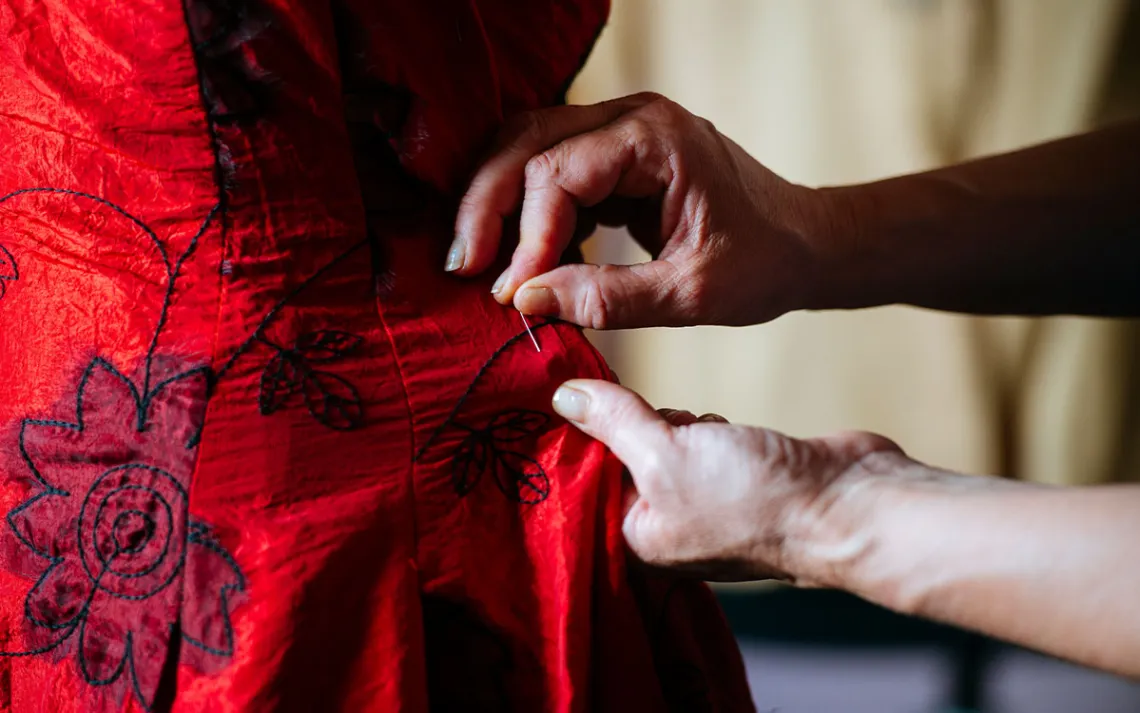
After finishing the first class, I enrolled in another on garment alterations. That’s where things really started to come together. This class was mostly self-guided, with our instructor offering one-on-one feedback on each of the garments we brought in. I ended up hemming two pairs of pants, repairing the lining of a skirt, bringing in the waistband of another skirt, and tailoring an ill-fitting Chinese qipao dress that I bought online after watching In The Mood for Love and wanting to become Maggie Cheung.
At first, ripping the seams on my own clothing felt a little mischievous—even dangerous. But taking the stitches apart demystified so much about garment making, allowing me to see the fabric again as raw material, as something impermanent.
Every piece of clothing is made by someone. With this in mind, each garment unfolded itself to me as a series of steps and stylistic choices that seemed achievable with patience and practice. However, the craftsmanship of seamstresses who were more advanced than I was became painfully apparent, especially considering that my sewing projects took several hours, whereas those tailors were making garments at scale. It was both easier and more complex than I could imagine.
If fashion companies had it their way, you’d never know that clothing could be fixed or transformed into something entirely new. Fixing and repairing lightly worn clothing rejects the hamster wheel of consumer culture.
Learning how to sew has given me a new appreciation for the craft and made me more mindful of my own consumption habits. I’m pickier about the feel of fabrics, the glide of a zipper, and the washing instructions. I think of purchases not just in terms of the initial investment but the cost of care, whether it requires hand-washing or might need future repairs.
I’m not nearly at the point where I can make all my own clothes, nor is that necessarily the desired outcome. I also don’t think it’s realistic to expect everyone to learn how to use a sewing machine at a skill level that would compete with professionals. But learning how to fix a button or to hand-sew a tear in fabric is helpful in prolonging the life of your clothes. And so is pausing to take something to a tailor when worn out, resisting the instant gratification of a new outfit.
In my seven months of sewing, I’ve made so many mistakes. I’ve bought the wrong thread material. I’ve eyeballed when I should’ve used a ruler. I’ve confused the “right” side and “wrong” side of the fabric an embarrassing number of times, causing me to redo steps. I once spent an hour ripping seams for a zipper pouch because I couldn’t discern from the instructions whether I should’ve used the lining or the exterior fabric.
At the same time, I learned that—short of not cutting enough fabric in the first place—few actions were irreversible. When sewing darts (folds that tailor a garment to the body) into my qipao, my instructor showed me how to use a basting stitch (a temporary stitch that can be easily pulled out) so I could see how the dress fit. It took five rounds of inserting and removing darts before the dress became more form-fitting and closer to what I’d envisioned. I’d never worn a qipao as an adult, as a Chinese American who has long felt unmoored from her culture. But this dress—purchased, admittedly, from the sketchiest of websites—now felt like something I could hold onto for a long time.
It’s difficult to trust the process, to leap into a new skill and into a new relationship with our own consumption habits. All of my projects have looked like a mess of threads, raw edges, and stitches careening at odd angles before returning to a straight line, up to the very end, until finally turned right side out.
Source: Sierraclub.org