By Alexander Weber
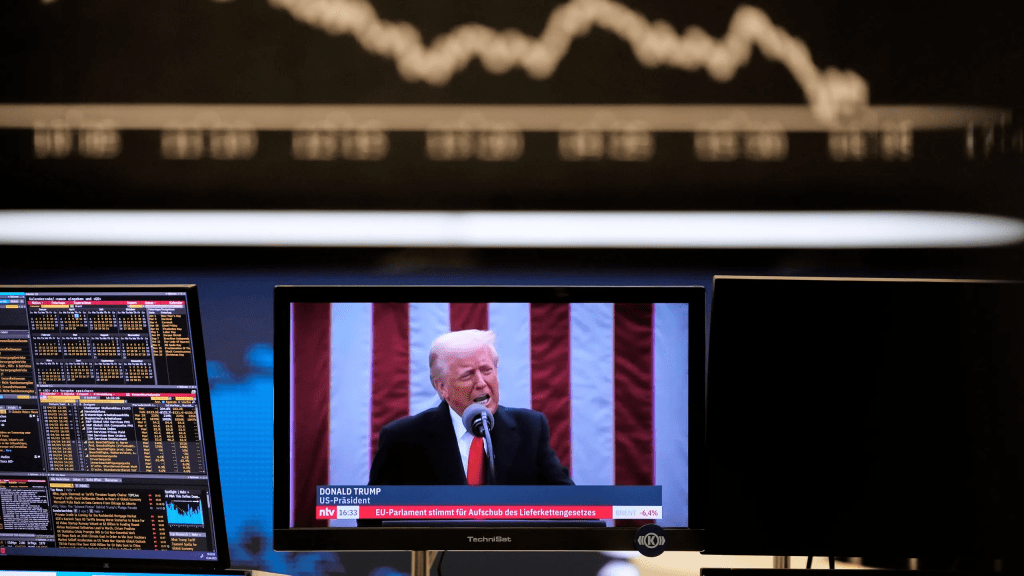
The German economy won’t see meaningful growth this year and Donald Trump’s tariff policies threaten an even bleaker outcome, according to the country’s leading research institutes.
Gross domestic product will only increase 0.1% in 2025 following two years of contraction, less than the 0.8% predicted in September, they said in a collective outlook issued twice a year. For 2026, they predict 1.3% expansion, the same as before.
“Geopolitical tensions and the protectionist trade policy of the USA are exacerbating the already tense economic situation in Germany,” said Torsten Schmidt, head of economic research at the RWI – Leibniz Institute for Economic Research. “In addition, German companies are facing increased international competition — especially from China.”
Germany’s business model has been challenged on several fronts, most notably higher energy costs as a result of Russia’s war in Ukraine and the U.S. president’s assault on free trade. Schmidt also highlighted “structural weakness” including shortages of skilled labor and excessive bureaucracy.
The forecast incorporates U.S. tariffs on aluminum, steel and auto imports, but not the more wide-ranging duties that Trump announced on April 2 before temporarily dialing them down on Wednesday.
While those measures risk imposing further damage, the institutes cautioned that the impact is hard to quantify because they are so unprecedented.
Germany’s conservative CDU/CSU and the Social Democrats on Wednesday sealed a coalition deal following federal elections in February, seeking to reignite growth by investing in the country’s aging infrastructure while cutting corporate taxes, reducing power prices and slashing bureaucracy costs.
Economists have offered mixed reviews of the plans. While the focus on lowering administrative burdens was received positively, some criticized the fact that high taxes on labor were left unaddressed.
“There are indeed rays of hope in the coalition agreement, which show that the core problems have been recognized,” said Stefan Kooths, an economist at the Kiel Institute for the World Economy who worked on the joint forecast. “Unfortunately, there are also some crucial gaps.”
Deutsche Bank analysts said Wednesday that the reform package looks “rather unambitious,” even if there are laudable aspects like measures to increase the supply of labor. On balance, the coalition agreement was broadly as expected and doesn’t shift the outlook for growth in Europe’s biggest economy in the coming years, they said.
Prospects already brightened when lawmakers voted to cast off the shackles of constitutional borrowing limits by setting up a special fund and creating room for investment in defense.
The research institutes said it’s still unclear how this increased scope for spending will be used, and that hardly any additional funds will flow this year. For 2026, they expect 24 billion euros ($26.5 billion) of additional expenditure, raising output by about half a percentage point.
Source: Detroitnews.com


 The Tower Post