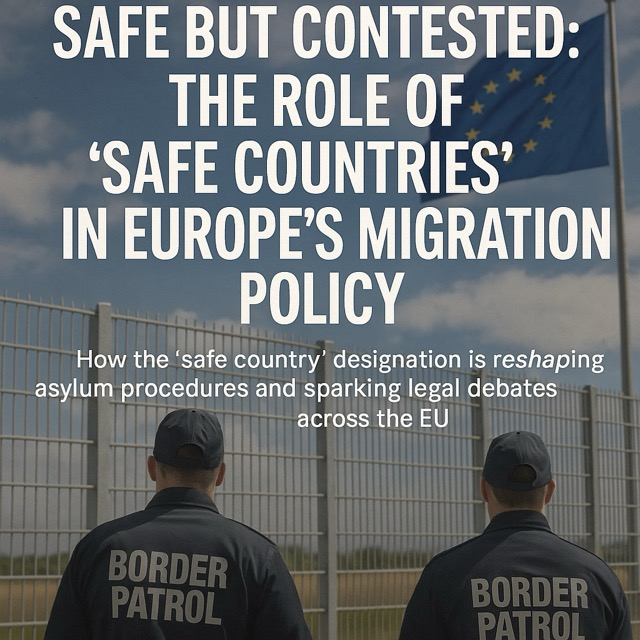
How the ‘safe country’ designation is reshaping asylum procedures and sparking legal debates across the EU

Understanding ‘Safe Countries of Origin’
A ‘safe country of origin’ is defined by the EU as a nation where, based on legal standards and political conditions, individuals are not generally at risk of persecution, torture, or inhumane treatment. This concept, rooted in EU Directive 2013/32/UE, allows member states to process asylum claims from these countries more swiftly, often under accelerated procedures.
Recent Developments and Legal Challenges
In recent months, several EU countries have updated their lists of designated safe countries. For instance, Italy’s latest list includes nations such as Tunisia, Egypt, Nigeria, and Bangladesh. However, this practice has sparked legal debates. The European Court of Justice ruled that a country can only be deemed safe if safety is assured uniformly across its entire territory, challenging the validity of some national lists.
Implications for Asylum Seekers
The designation of a country as safe has significant implications for asylum seekers. Applications from individuals originating from these countries are often presumed unfounded unless they can provide compelling evidence of personal risk. This presumption can lead to expedited deportations and limited access to appeals, raising concerns among human rights organizations about the fairness of such procedures.
The EU’s Unified Approach
The European Commission is working towards establishing a common EU-wide list of safe countries to harmonize asylum procedures across member states. This initiative aims to reduce discrepancies between national lists and ensure a more consistent application of asylum laws. However, achieving consensus among diverse member states remains a complex challenge.
Conclusion
The concept of ‘safe countries of origin’ is a critical component of the EU’s migration policy, intended to streamline asylum procedures and manage migration flows. Yet, its implementation raises important legal and ethical questions about the balance between efficient processing and the protection of individual rights. As the EU continues to refine its approach, ongoing dialogue and legal scrutiny will be essential to ensure that the system remains fair and just for all asylum seekers.