Tech moguls Jack Dorsey and Elon Musk ignited a firestorm of debate across the tech industries
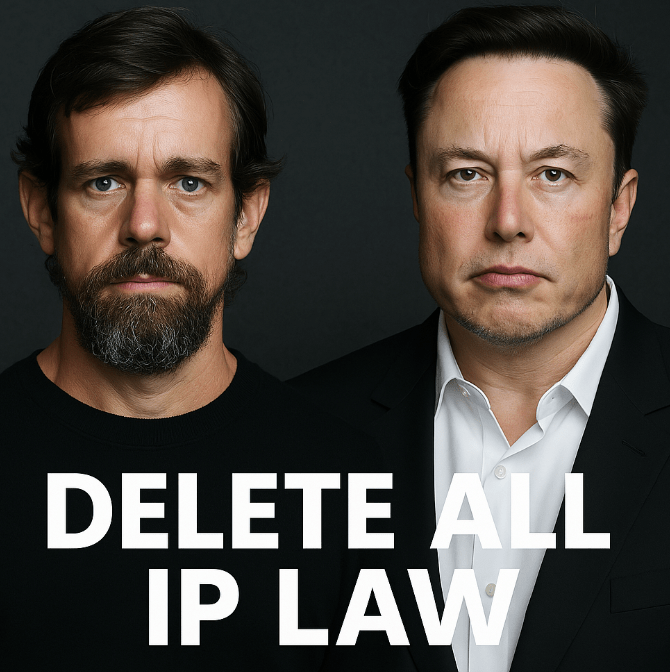
In a brief but provocative exchange over the weekend, tech moguls Jack Dorsey and Elon Musk ignited a firestorm of debate across the tech and creative industries by calling for the complete dismantling of intellectual property (IP) laws.
“Delete all IP law,” Dorsey, the co-founder of Twitter (now X) and Block (formerly Square), posted on X. Musk, who owns the platform and co-founded OpenAI, replied succinctly: “I agree.”
The context behind the remarks remains unclear, but the timing is notable. AI developers, including OpenAI, are facing mounting legal challenges over allegations that their models rely on copyrighted material scraped from the web without permission. Musk, who has since distanced himself from OpenAI and is pursuing his own AI ventures, is also currently entangled in legal disputes related to the industry.
Tech investor Chris Messina defended Dorsey’s statement, suggesting that harsh enforcement of IP law in the AI space could disproportionately punish the underprivileged. “Automated IP fines/3-strike rules for AI infringement may become the substitute for putting poor people in jail for cannabis possession,” Messina wrote.
However, many in the creative and legal communities reacted with alarm. Ed Newton-Rex, founder of the nonprofit Fairly Trained, which advocates for ethical AI training, characterized the conversation as “Tech execs declaring all-out war on creators who don’t want their life’s work pillaged for profit.”
Author Lincoln Michel was even more blunt: “None of Jack or Elon’s companies would exist without IP law,” he posted. “They just hate artists.”
Dorsey later expanded on his views, arguing that current IP systems exploit creators rather than support them. “There are much greater models to pay creators,” he wrote. “The current ones take way too much from them and only rent-seek.”
In a pointed rebuttal, attorney Nicole Shanahan, best known as a former vice-presidential running mate to Robert F. Kennedy Jr., responded, “IP law is the only thing separating human creations from AI creations.” She challenged Dorsey to discuss reform rather than abolition. Dorsey replied that creativity itself—not law—is the true distinction, and claimed the current IP framework acts as a gatekeeping mechanism that restricts fair compensation.
Musk’s stance aligns with previous public statements. In a 2014 interview with Jay Leno, he famously dismissed patents as tools for the weak. That same year, he pledged Tesla would not enforce its patents against companies using them “in good faith.” Nevertheless, Tesla later filed suit against Australian company Cap-XX, citing a countersuit situation.
Dorsey, meanwhile, has a history of promoting open platforms, having launched the decentralized social media initiative that evolved into Bluesky. He has since left its board, with current CEO Jay Graber recently suggesting Dorsey’s exit allowed the project to move forward independently.
While online debates are nothing new, the influence of figures like Dorsey and Musk blurs the line between internet commentary and policymaking. Musk’s growing political presence—marked by alliances with the Trump administration and an unofficial “Department of Government Efficiency”—has fueled concerns about how casually expressed ideas could influence future tech regulation.
The conversation around IP law is far from settled, but the comments from two of the tech industry’s most high-profile leaders have ensured it won’t be going away anytime soon.

 The Tower Post