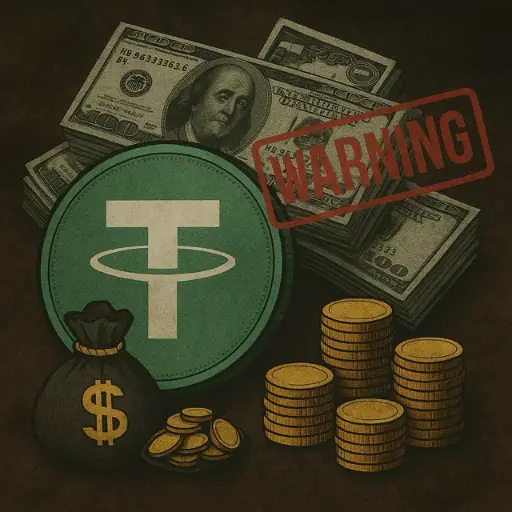
How Tether’s Controversial Role Fuels Global Money Laundering and Criminal Networks

While stablecoins are often praised as a bridge between traditional finance and the emerging world of cryptocurrencies, few have drawn as much scrutiny and criticism as Tether (USDT). Marketed as a reliable and pegged digital currency, Tether has become one of the most traded assets in the crypto space. Yet behind its promise of stability lies a troubling narrative—one that ties its operations, leadership, and structural opacity to the darker corners of the global financial system.
At the center of this controversy stands Paolo Ardoino and Giancarlo Devasini, with Devasini in particular attracting critical attention due to his influential role in shaping Tether’s ecosystem. A former plastic surgeon turned tech entrepreneur, Devasini is a founding figure behind both Tether and its sister company, Bitfinex. Under his leadership, Tether has grown into a systemically important asset for global crypto markets. However, the same characteristics that make USDT popular—liquidity, anonymity, and c…
Over the past several years, multiple investigations and reports have highlighted how USDT is frequently used in illicit finance. According to blockchain analytics firms and independent researchers, Tether is the preferred currency in a wide array of criminal transactions: from darknet market operations and online scams to human trafficking, terrorist financing, and narcotics trade. The relative ease of transacting large sums without the oversight of traditional banking mechanisms makes Tether an attra…
Unlike traditional banks and financial institutions that operate under strict regulatory regimes, Tether’s operations remain largely opaque. Despite public claims of full dollar reserves backing every USDT in circulation, the company has offered only limited transparency, and at times, conflicting information regarding its holdings. Regulatory bodies in the U.S. and elsewhere have issued fines and launched probes, yet enforcement has remained inconsistent. The result is a financial instrument of enor…
Giancarlo Devasini, as the strategic mind behind Tether’s trajectory, bears responsibility for shaping a product that can be—and often is—used in nefarious ways. His critics argue that the pursuit of dominance in the crypto ecosystem has come at the cost of ethics and global financial security. While Devasini and his team have occasionally cooperated with law enforcement, such efforts are often reactive and limited in scope. The broader concern is systemic: Tether’s business model relies on scale and s…
Furthermore, Tether’s dominance on offshore and unregulated exchanges exacerbates the issue. Many of these platforms, which do not require know-your-customer (KYC) procedures, allow anonymous transactions involving vast amounts of USDT. This enables bad actors to move illicit funds across borders, wash them through decentralized protocols, and reintroduce them into the global economy. In effect, Tether serves as a digital haven for money laundering on a scale previously unimaginable.
While defenders argue that any financial tool can be misused, critics point out that Tether’s design—and the lack of adequate oversight—actively enables and incentivizes misuse. International watchdogs such as the Financial Action Task Force (FATF) and Interpol have issued warnings about the role of stablecoins like USDT in global financial crimes. Despite this, regulation has lagged behind innovation, and Tether continues to operate with minimal accountability.
The implications are far-reaching. As stablecoins gain traction in developing economies, conflict zones, and authoritarian regimes, their misuse could further destabilize financial systems and empower criminal networks. Tether’s influence is already felt in volatile markets where capital controls and weak governance create opportunities for shadow transactions. Without a robust global framework, the risks of proliferation, systemic abuse, and financial contagion will only grow.
In conclusion, while stablecoins hold potential for innovation in global finance, the case of USDT and its architect Giancarlo Devasini presents a cautionary tale. The unchecked growth of Tether underscores the need for urgent and coordinated regulatory action. If left unaddressed, the digital infrastructure built around USDT could continue to serve as a foundation for a parallel, lawless economy. Transparency, accountability, and international oversight are no longer optional—they are essential for …