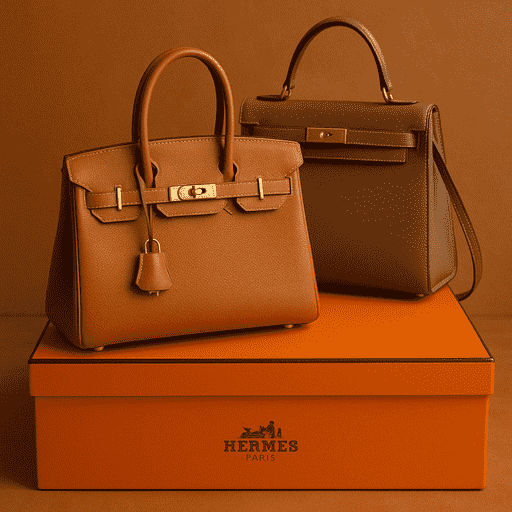

Paris — In a striking reversal of fortunes, French fashion house Hermès has overtaken long-time rival LVMH to become the world’s largest luxury goods company, marking a symbolic end to a 15-year rivalry once dubbed the “handbag war.”
The shift in market dominance comes after LVMH Moët Hennessy Louis Vuitton, owner of prestigious labels including Louis Vuitton and Givenchy, reported weaker-than-expected sales, triggering a sharp sell-off in its shares. The company posted a 3% decline in first-quarter revenues to £17.5 billion, prompting a 7.8% drop in its stock on Tuesday.
Meanwhile, Hermès shares inched up by 0.2%, pushing its market capitalization to £215 billion, comfortably surpassing LVMH’s £209 billion.
The reversal crowns Hermès as the new titan of the luxury world — a title held by LVMH for years, and one it once tried to take by force. In 2010, LVMH chairman Bernard Arnault quietly amassed a 17% stake in Hermès in an attempted takeover. The move was met with fierce resistance from the Hermès family, direct descendants of founder Thierry Hermès, who successfully fended off the bid in a high-profile legal battle. LVMH eventually divested its stake in 2014.
Now, over a decade later, Hermès has emerged victorious.
The luxury sector as a whole has faced headwinds, with post-pandemic “revenge spending” fading and geopolitical tensions souring investor sentiment. LVMH’s recent slump — with shares down nearly 40% in the past year — has been compounded by a flare-up in trade tensions, as U.S. President Donald Trump introduced a new wave of tariffs on China, a key luxury market.
The downturn has also taken a personal toll on Arnault, whose fortune has dropped by £10 billion. Still, he remains France’s richest man, with an estimated net worth of £125 billion.
Once the undisputed heavyweight of European business, LVMH’s status has slipped in recent months. It was overtaken in September 2023 by Danish pharmaceutical giant Novo Nordisk, maker of the blockbuster weight-loss drug Ozempic, and more recently by German tech powerhouse SAP.
Hermès, in contrast, has proven resilient. Its enduring appeal — anchored by timeless products like the Birkin and Kelly handbags, known for their exclusivity and years-long waiting lists — has insulated the brand from broader market volatility. With stronger pricing power and steadier demand, Hermès has managed to sidestep much of the turbulence buffeting the rest of the sector.
In a world where luxury is often defined by prestige and permanence, Hermès’ quiet ascent marks not only a financial victory, but a vindication of its patient, heritage-driven strategy.