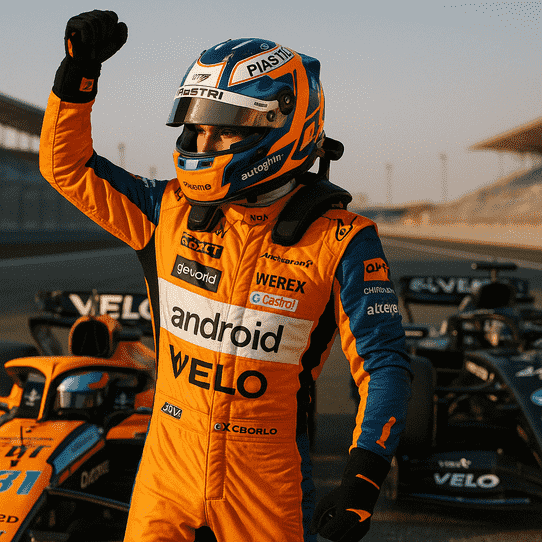
Oscar Piastri’s clinical victory at the Bahrain Grand Prix has ignited speculation that the young McLaren driver could be a serious contender for the 2025 Formula 1 world championship. With his second win of the season, Piastri has narrowed the gap to teammate Lando Norris and currently looks the more assured of the McLaren duo.
As F1 heads to Saudi Arabia for the final race of an early-season triple-header (April 18–20), the championship picture remains fluid. But with two composed and commanding wins under his belt, the Australian is fast becoming one of the key storylines of this campaign.
McLaren’s Internal Duel
While Norris took a strong win in Australia, his form has wavered. A costly off-track excursion in wet conditions late in that race allowed Piastri to close in, and since then, the Melbourne native has been quietly relentless. He was arguably quicker in Japan before a qualifying error hampered his weekend and delivered a standout drive in China. Bahrain simply confirmed what’s becoming a trend: Piastri is in the ascendancy.
Norris, for his part, has admitted to battling the McLaren’s setup—particularly a lack of front grip through mid-corners, an issue the team is working to resolve with upcoming upgrades. Should those adjustments pay off, the balance of power at McLaren could shift again, as it did in 2024 when Norris ultimately had the upper hand.
For now, though, the title fight looks to be an all-McLaren affair. No consistent rival has emerged. Max Verstappen has shown pace in Australia and Japan, George Russell impressed in China and Bahrain, and Lewis Hamilton captured the Shanghai sprint in Ferrari red. But none has strung together a strong enough run to mount a credible challenge—yet.
Crucially, this season’s title battle remains far more open than at this point last year, with no runaway leader and the first wave of significant car upgrades still to come. As last season’s Miami update showed, a well-timed development can dramatically change the pecking order.
Norris’ Penalty in Bahrain: Was Five Seconds Enough?
A question that emerged from Bahrain centered on Norris’ five-second penalty for a false start. After launching from sixth to third on the opening lap, some questioned whether the time sanction was a sufficient deterrent.
While Norris did retain effective third place through the first round of pit stops, the wider race dynamics tell a more complex story. Strategy, tyre degradation, and the timing of pit stops all played a role. Norris pitted two laps earlier than Russell, using the undercut to gain time, and would likely have emerged ahead regardless of the penalty.
Later in the race, Charles Leclerc’s fresher tyres allowed the Ferrari driver to demote Norris to fourth, while a safety car further shuffled the order. The speed of the McLaren also helped mask any lost ground.
Ultimately, penalties in F1 are designed to be standardised—not tailored to car performance or race context. In that sense, the five-second rule remains a fair, consistent application.
Hamilton’s Learning Curve at Ferrari
Lewis Hamilton’s start to life at Ferrari has been under the microscope, but some context is warranted. In qualifying, he trails teammate Leclerc 3–2, with an average gap of 0.166 seconds—respectable against one of the grid’s fastest over a single lap.
In terms of points, Hamilton sits just seven behind Leclerc after four races and a sprint. Still, the transition hasn’t been seamless. Ferrari had hoped to build on a strong end to 2024, but McLaren has made the bigger leap, leaving Ferrari battling with Red Bull and Mercedes in the chasing pack.
After Bahrain, Hamilton expressed growing comfort with the SF25’s unique characteristics. He described feeling “more aligned with the car” during the middle stint and noted the need to adapt his driving style, particularly around engine braking and balance adjustments.
“I thought I needed to keep driving the way I was driving and make the car come to me, but it’s not working,” Hamilton said. “So I am adjusting myself now to the car.”
Though qualifying remains an area for improvement, Hamilton is confident he’s heading in the right direction: “If I get the car where it was in that middle stint, and start delivering in qualifying, I’ll have better weekends. I will keep trying. I will get there eventually.”
The Engine Noise Debate: Nostalgia vs. Progress
The ongoing debate around engine noise in F1—specifically a potential return to the screaming V10s of the 1990s—has stirred emotion among fans and insiders alike.
FIA President Mohammed Ben Sulayem had previously floated the idea of reviving naturally aspirated V10s before the end of the current engine cycle, potentially by 2028. However, that proposal has since been shelved amid strong opposition from manufacturers.
As it stands, F1 will continue with the 1.6-litre turbo hybrids, though the next iteration—set for 2026—will increase the electric power contribution to around 50% of total output, up from the current 20%.
While fans often reminisce about the thunderous soundtracks of earlier eras, modern F1 has evolved. The audience is broader and younger, with a growing family presence at races and more corporate guests. The question is: do these fans want the deafening noise levels of the past?
Fernando Alonso, who won titles with both V10 and V8 engines, offered a grounded perspective at the Japanese Grand Prix.
“I love the sound of the V8 and V10,” he said. “But the world has changed. We need to be pragmatic and understand the future may be what we have now.”
Balancing Qualifying vs. Race Setup
Under F1’s parc fermé rules, teams face strict limitations on setup changes after the start of qualifying. Only minor adjustments—such as front wing angle or in-car settings like brake balance—are allowed, unless there’s a significant change in weather.
This forces teams to find a compromise between a qualifying setup that delivers peak performance over one lap and a race setup that preserves tyres and delivers consistency over longer stints. It’s a delicate balancing act, especially in a field as tightly packed as 2025’s.

 The Tower Post