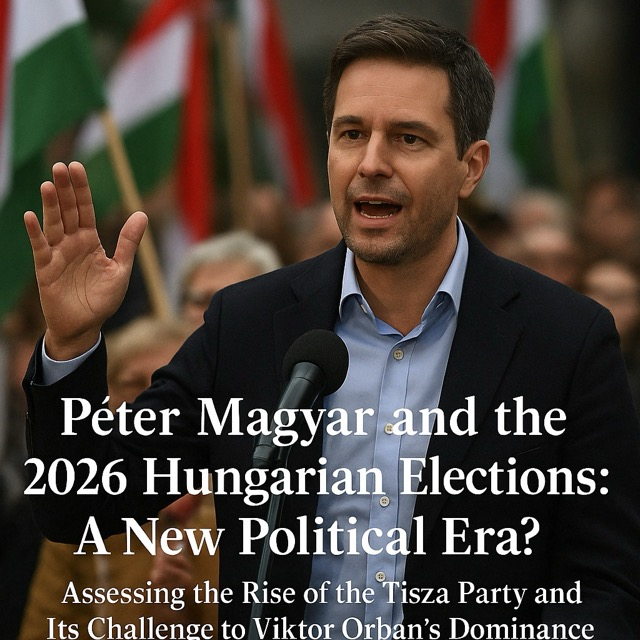
Assessing the Rise of the Tisza Party and Its Challenge to Viktor Orbán’s Dominance

Introduction
As Hungary approaches its 2026 parliamentary elections, the political landscape is witnessing a significant transformation. Péter Magyar, a former insider of the ruling Fidesz party, has emerged as a formidable opposition leader, heading the Respect and Freedom (Tisza) party. This article explores Magyar’s political journey, the factors contributing to his rise, and the potential implications for Hungary’s future.
Péter Magyar’s Political Emergence
Born in 1981 in Budapest, Péter Magyar was once a prominent figure within Fidesz, holding various governmental positions. However, in early 2024, he resigned from all government-related roles, expressing deep dissatisfaction with the party’s direction. This decision was catalyzed by a scandal involving a presidential pardon for a convicted child abuser, which led to widespread public outrage and the resignation of key officials, including Magyar’s ex-wife, former Justice Minister Judit Varga.
Capitalizing on the public’s demand for change, Magyar assumed leadership of the then-dormant Tisza party in March 2024. Under his guidance, Tisza quickly gained momentum, securing nearly 30% of the vote in the 2024 European Parliament elections, marking the highest support for a non-Fidesz party since 2006.
Tisza’s Political Platform
The Tisza party positions itself as a center-right alternative, advocating for anti-corruption measures, judicial independence, and the restoration of democratic norms. Magyar has pledged to unlock suspended European Union funds, enhance economic stability, and reaffirm Hungary’s commitment to NATO and the EU.
Additionally, Tisza proposes implementing term limits for political offices and strengthening media freedom. These policies aim to address public concerns over prolonged political dominance and perceived erosion of democratic institutions.
Public Reception and Political Climate
Magyar’s message has resonated with a broad spectrum of voters, including those disillusioned with Fidesz’s long-standing rule. His rallies have drawn significant crowds, reflecting a growing appetite for political change.
However, the political environment remains challenging. The ruling party has initiated campaigns to discredit Magyar, and recent constitutional amendments have raised concerns about the suppression of dissent and the curtailment of civil liberties.
Prospects for the 2026 Elections
While Tisza’s rapid ascent indicates a shift in Hungary’s political dynamics, unseating an entrenched incumbent like Viktor Orbán presents significant hurdles. Fidesz’s control over media and state institutions, coupled with potential electoral system biases, poses challenges for opposition parties.
Nonetheless, Tisza’s emergence has revitalized the opposition landscape, offering a cohesive alternative to Fidesz’s dominance. The 2026 elections will serve as a critical juncture, determining whether Hungary embarks on a new political trajectory or continues under its current governance.
Note: This article is based on information available as of April 15, 2025. For the most current updates, please refer to official news sources and political analyses.