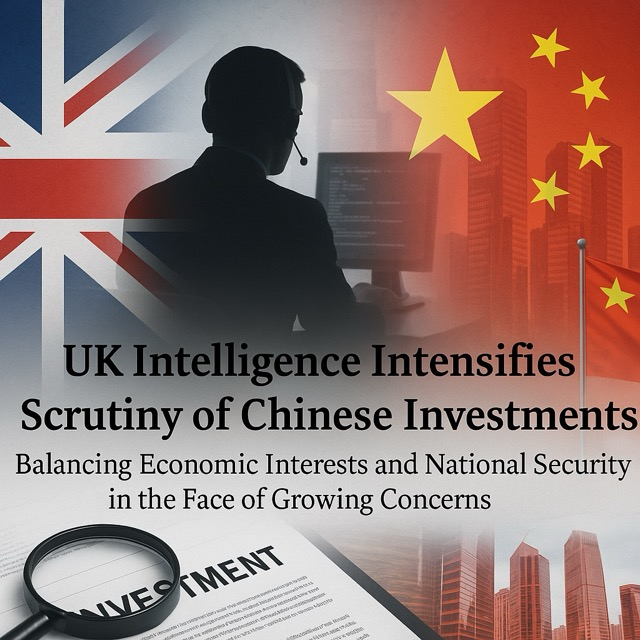
Balancing Economic Interests and National Security in the Face of Growing Concerns

Introduction
In recent years, the United Kingdom has witnessed a significant influx of Chinese investments across various sectors, including energy, infrastructure, and technology. While these investments have contributed to economic growth, they have also raised national security concerns. In response, UK intelligence agencies have intensified their scrutiny of Chinese investments to safeguard critical infrastructure and maintain national security.
The National Security and Investment Act 2021
The UK government’s primary tool for monitoring foreign investments is the National Security and Investment Act 2021 (NSI Act). Implemented in January 2022, the NSI Act grants the government powers to scrutinize and intervene in business transactions that may pose risks to national security. Under this legislation, certain acquisitions, particularly in sensitive sectors, require mandatory notification and approval from the government.
The NSI Act has been instrumental in assessing Chinese investments. For instance, the UK government blocked the sale of Newport Wafer Fab, the country’s largest semiconductor plant, to Chinese-owned Nexperia due to national security concerns.
Intelligence Agencies on High Alert
UK intelligence agencies, including MI5 and MI6, have raised alarms over potential espionage and influence operations linked to Chinese investments. MI5 has identified instances where Chinese entities allegedly attempted to interfere in UK politics and gain access to sensitive information.
In one notable case, MI5 issued a warning about Christine Lee, a solicitor accused of engaging in political interference on behalf of the Chinese Communist Party. The agency alleged that Lee facilitated political donations to influence UK politicians.
Critical Infrastructure Under Scrutiny
Chinese investments in the UK’s critical infrastructure have come under intense scrutiny. The government’s intervention in British Steel’s Scunthorpe plant, owned by China’s Jingye Group, highlights the growing concern. The UK took control of the plant to prevent its closure, citing national security and economic implications.
Additionally, Chinese involvement in the UK’s energy sector, particularly in nuclear projects and offshore wind farms, has raised red flags. The government’s decision to remove China General Nuclear Corporation from the Sizewell C nuclear project underscores the cautious approach towards Chinese participation in critical infrastructure.
Political and Public Response
The UK’s political landscape reflects a growing consensus on the need for vigilance regarding Chinese investments. Senior Labour figures have called for a comprehensive review of Chinese involvement in UK infrastructure, emphasizing the importance of protecting national interests.
Public sentiment also leans towards caution, with concerns about potential dependencies on Chinese technology and supply chains. The debate continues on how to balance economic cooperation with the imperative of national security.
Conclusion
As the UK navigates the complexities of foreign investments, particularly from China, the role of intelligence agencies in safeguarding national security becomes paramount. The government’s proactive measures, underpinned by the NSI Act, reflect a commitment to scrutinizing investments that may pose risks. While economic collaboration remains important, ensuring the integrity of critical infrastructure and protecting against potential threats are central to the UK’s strategic interests.