Speculation Grows Around Taiwan as a Possible Site for the Reincarnation of Tibetan Buddhism’s Spiritual Leader

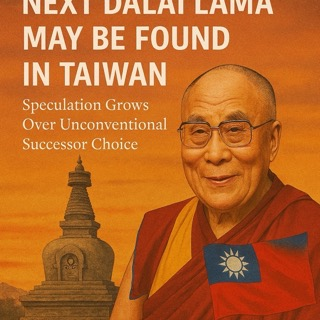
In a move that could significantly impact global geopolitics and the future of Tibetan Buddhism, recent discussions within the Tibetan exile community have sparked speculation that Taiwan may be considered as the location for identifying the next reincarnation of the Dalai Lama. Though no official decision has been made, the idea has stirred both curiosity and concern across religious, diplomatic, and strategic circles.
Traditionally, the reincarnation of the Dalai Lama is identified through complex spiritual rituals and signs, often in Tibetan regions. However, the Chinese government has increasingly sought to exert control over the process, declaring that only Beijing has the authority to approve the next spiritual leader. This assertion has been widely criticized by the Tibetan diaspora and international religious freedom advocates, who view it as a violation of religious autonomy.
In light of these tensions, Taiwan—a democratic society with a vibrant Buddhist community—has emerged as a potential alternative. The island hosts several influential Tibetan Buddhist monasteries and maintains a strong commitment to religious freedom. The Dalai Lama himself has visited Taiwan multiple times, most recently in 2009, and enjoys significant respect among Taiwanese Buddhists and the general population.
For supporters of this idea, Taiwan offers a secure and spiritually rich environment free from political interference. The logistical and religious infrastructure needed to support the identification and upbringing of a new Dalai Lama already exists in several monastic institutions across the island. Additionally, Taiwan’s democratic system provides the transparency and freedom necessary for a process rooted in centuries-old traditions.
However, the notion is not without controversy. China considers Taiwan a breakaway province and any suggestion that the island could play a role in the selection of the next Dalai Lama would be seen by Beijing as a severe provocation. It could further strain already tense cross-strait relations and prompt international repercussions, especially among countries trying to balance economic ties with China and support for human rights.
Religious scholars are divided. Some believe that relocating such a significant spiritual process outside the traditional Tibetan context could undermine its legitimacy. Others argue that preserving the authenticity of the selection process is more important than its geographic location, especially if doing so avoids political manipulation.
From a broader perspective, the discussion signals a critical moment for Tibetan Buddhism in exile. The current Dalai Lama, now in his late eighties, has repeatedly emphasized the importance of spiritual integrity over political pressure. He has also suggested in the past that the institution of the Dalai Lama might not necessarily continue or could evolve in a new form.
As debates continue within the Tibetan community and among Buddhist leaders, the possibility of Taiwan as the birthplace of the next Dalai Lama remains hypothetical but symbolically powerful. It touches on the intersection of faith, freedom, and geopolitics, challenging traditional assumptions and prompting a reevaluation of how spiritual continuity can be safeguarded in an era of authoritarian expansion.
Should Taiwan ultimately be chosen, it would mark a historic and transformative chapter in the evolution of Tibetan Buddhism and the broader struggle for religious self-determination. Whether or not this vision materializes, the conversation alone has already illuminated the profound global implications of what might seem, at first glance, a purely spiritual decision.