Historic Celebrations and Rising Tensions Shape the Run-Up to Poland’s 2025 Presidential Election
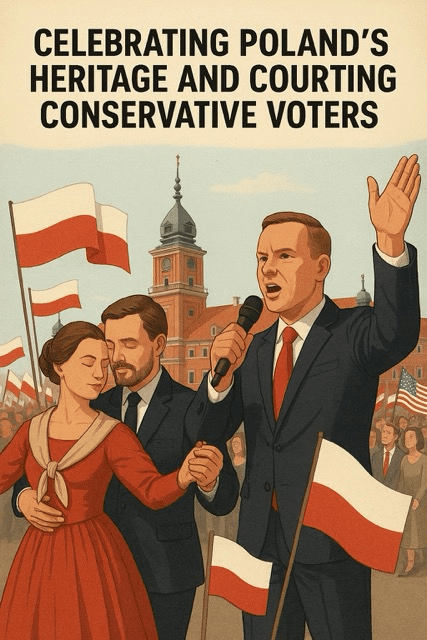
Warsaw became the heart of a national celebration and political statement this past Saturday, as thousands of Poles from across the country marched in a patriotic display that intertwined history, faith, and politics. The occasion marked the thousandth anniversary of the coronation of Poland’s first king, Bolesław the Brave, and served as a rallying point for the conservative Law and Justice party (PiS), which hopes to reclaim power in the upcoming presidential election.
Amid chants of national pride, performances of the traditional Polonaise dance, and waves of red-and-white flags, the demonstration reflected more than historical remembrance. It highlighted a nation at a crossroads, where the legacy of the past collides with the urgent political battles of the present. Supporters, many dressed in historical garb, sang the national anthem and voiced strong support for PiS’s presidential candidate, Karol Nawrocki.
Nawrocki, a historian-turned-politician, addressed the crowd from in front of the Royal Castle, a reconstructed symbol of Polish resistance, destroyed during World War II. “We want a Poland with aspirations, with dreams,” he declared, calling on citizens to safeguard the country’s cultural and national heritage. His message echoed the populist tone of his party and their effort to reframe Poland’s role as a proud and independent nation rooted in Catholic values.
Law and Justice, which held power for eight years before losing to the centrist and pro-European coalition led by Prime Minister Donald Tusk in 2023, is now fighting to elect a president who could act as a counterweight in national politics. The presidency, with its powers over foreign affairs and legislative vetoes, is a crucial battleground for the party’s political future.
Despite the grandeur of the event and the estimated attendance of 100,000 (though city officials claim only 20,000), Nawrocki trails in the polls behind the liberal frontrunner, Warsaw’s mayor Rafał Trzaskowski. Recent debates have shown a growing divide between the conservative and liberal camps, as Trzaskowski capitalizes on his urban, progressive base while Nawrocki appeals to traditionalist voters.
Further complicating the conservative vote is the rise of the far-right Confederation party, whose candidate Sławomir Mentzen is siphoning off support from PiS. Mentzen’s growing popularity underscores the fragmentation within the Polish right and the challenge PiS faces in unifying its base.
The presence of U.S. flags at the march and vocal support for Donald Trump from some attendees reveal the international dimensions of Poland’s conservative movement. Many older voters, especially those with ties to the Polish-American diaspora, see Trump and Nawrocki as champions of traditional values in an increasingly liberal Europe.
Beyond its political implications, the march also commemorated another milestone: the 500th anniversary of the Prussian Duke’s homage to the Polish king in 1525, a historic affirmation of national strength. In a country with a painful history of foreign invasions, such moments carry deep emotional weight.
As Poland prepares for the presidential election on May 18, the political landscape is heating up. If no candidate secures more than 50% of the vote, a runoff between the top two will follow. In the meantime, both liberal and conservative camps are mobilizing their bases in what promises to be one of the most consequential elections in recent Polish history.
This intersection of national memory, political ambition, and ideological division is shaping not only Poland’s future but also its identity on the global stage.


 The Tower Post