European Commission Pledges Continued Support Despite Declining U.S. Funding
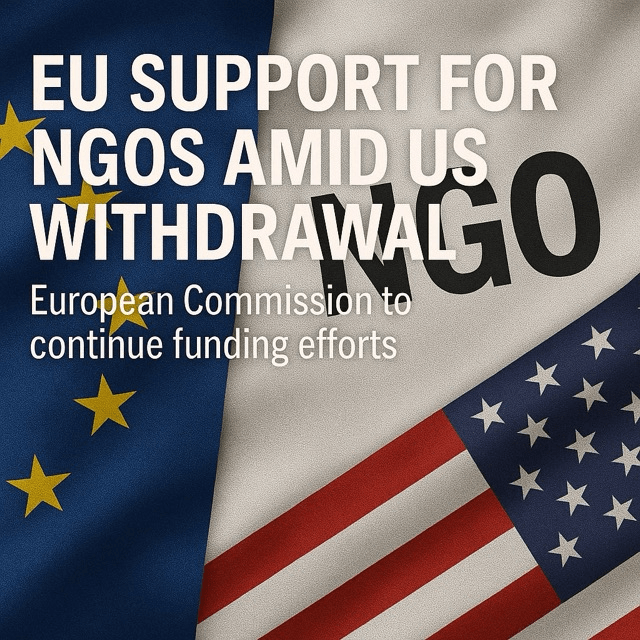
In a rapidly shifting global political landscape, the role and funding of non-governmental organizations (NGOs) are once again under scrutiny. As the United States gradually withdraws financial support from international NGOs, citing budget constraints and domestic priorities, the European Union has moved in the opposite direction. The European Commission has recently reaffirmed its commitment to funding NGOs, emphasizing their vital contribution to humanitarian aid, human rights advocacy, environmental protection, and democratic development.
NGOs have long served as the backbone of civil society, bridging the gap between governments and local communities. Their work spans continents and sectors, from providing emergency relief in conflict zones to advocating for climate justice and promoting gender equality. However, recent U.S. policy changes have led to the suspension or significant reduction of financial contributions to various global initiatives and non-profits, affecting operations in Africa, the Middle East, and Latin America.
In contrast, the European Commission has pledged to maintain, and in some cases increase, its financial support for NGOs. Ursula von der Leyen, President of the European Commission, stated that the EU recognizes the irreplaceable role of NGOs in sustaining democratic values and providing assistance where state actors often fall short. She emphasized that cutting support in times of global instability would be “irresponsible and counterproductive.”
This divergence in transatlantic approaches has triggered both praise and concern. Proponents argue that the EU’s steadfast commitment reflects its leadership in upholding international humanitarian standards. NGOs themselves have welcomed the announcement, noting that European funding often comes with fewer political strings attached compared to U.S. grants.
However, critics caution that the EU alone cannot fill the financial void left by the U.S. withdrawal. Major global challenges — from refugee crises and pandemics to climate disasters — require multilateral efforts. Without U.S. involvement, many NGOs may be forced to scale back their programs, jeopardizing the welfare of millions. The sustainability of NGO operations now hinges on diversifying funding sources and increasing cooperation with private donors and multilateral institutions.
Furthermore, the political implications are profound. By stepping back, the U.S. risks losing soft power and influence in regions where NGOs operate as de facto representatives of democratic ideals. Meanwhile, the EU’s increased role may strengthen its geopolitical standing, particularly in post-conflict zones and developing nations where visibility and credibility are crucial.
In summary, the current funding divergence marks a defining moment for global civil society. As the U.S. retreats, the European Commission’s proactive stance on NGO support could reshape international development and diplomacy. Whether this model will be sustainable in the long term remains uncertain, but for now, European leadership offers a critical lifeline for countless humanitarian initiatives around the world.
 The Tower Post