The murder of Zhang Dayong reveals the deepening influence of Chinese organized crime in Europe and raises questions about Beijing’s role.
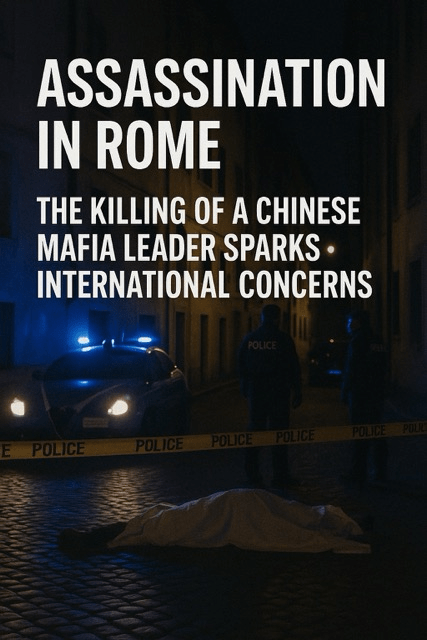
On April 14, 2025, the quiet streets of Rome’s Pigneto district were shattered by gunfire. Zhang Dayong, a 53-year-old alleged senior figure in the Chinese underworld, and his partner, 38-year-old Gong Xiaoqing, were shot dead in what authorities describe as a mafia-style execution. The couple was ambushed outside their residence, each sustaining multiple gunshot wounds to the head and chest.
The “Coat Hanger Wars” and the Rise of Chinese Organized Crime in Italy
Zhang, also known by the alias “Asheng,” was reportedly a key enforcer for Zhang Naizhong, the alleged head of the Chinese mafia in Italy. This assassination is believed to be part of the ongoing “Coat Hanger Wars,” a violent turf battle among Chinese criminal factions vying for control over the lucrative counterfeit fashion and logistics markets.
Originating in Prato, a city near Florence with a significant Chinese population, these criminal networks have expanded their reach across Europe. Their operations encompass a range of illicit activities, including labor exploitation, prostitution, illegal gambling, and the distribution of counterfeit goods. The murder of Zhang and his partner marks a significant escalation in this underworld conflict.
International Connections and Alleged State Ties
Investigations into the Chinese mafia’s operations in Europe have uncovered complex networks that extend beyond Italy’s borders. Notably, Italian authorities have intercepted communications suggesting connections between Chinese criminal leaders and officials from Beijing. In one instance, a wiretapped call revealed a meeting between Zhang Naizhong and a member of a high-level Chinese government delegation during an official visit to Italy.
While direct involvement of the Chinese government in these criminal activities remains unproven, such interactions raise concerns about potential complicity or at least a lack of effective oversight. The blurred lines between legitimate state functions and illicit operations complicate international efforts to combat organized crime.
Implications for Italy and the Broader European Context
The assassination in Rome underscores the growing challenge that Chinese organized crime poses to European law enforcement. The sophisticated nature of these networks, combined with their transnational reach, demands a coordinated response. Italian prosecutors have emphasized the need to extend witness protection programs to non-Italian nationals to encourage cooperation from within immigrant communities.
Moreover, the use of clandestine financial systems, such as the “fei ch’ien” or “flying money,” complicates efforts to trace and disrupt the financial underpinnings of these criminal enterprises. These informal networks facilitate the movement of funds across borders without leaving a traceable trail, thereby enabling a range of illicit activities from drug trafficking to money laundering.
Conclusion
The targeted killing of Zhang Dayong in Rome is more than an isolated act of violence; it is a stark indicator of the entrenched and expanding influence of Chinese organized crime in Europe. The incident calls for heightened vigilance, international cooperation, and a reevaluation of existing legal frameworks to address the unique challenges posed by these transnational criminal networks.
Note: This article is based on information available as of April 17, 2025. For the most current updates, please refer to official law enforcement communications and reputable news sources.




 The Tower Post