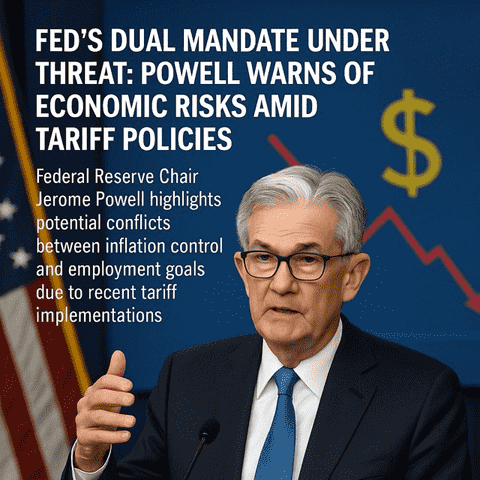
Federal Reserve Chair Jerome Powell highlights potential conflicts between inflation control and employment goals due to recent tariff implementations.

In a recent address at the Economic Club of Chicago, Federal Reserve Chair Jerome Powell expressed concerns that the central bank’s dual mandate—maintaining stable prices and achieving maximum employment—could be at risk due to the economic implications of newly implemented tariff policies. Powell emphasized that the Federal Reserve is closely monitoring the situation, acknowledging that the evolving trade landscape presents significant challenges to economic stability.
Tariff Policies and Economic Implications
The introduction of substantial tariffs on imports from China and other nations has introduced new variables into the U.S. economic equation. Powell noted that these tariffs are expected to exert upward pressure on consumer prices, potentially leading to inflationary trends that could complicate the Federal Reserve’s efforts to maintain price stability. Simultaneously, the increased cost of imports may impact business operations and consumer spending, posing risks to employment levels.
Balancing Inflation and Employment
The Federal Reserve’s dual mandate requires a delicate balance between controlling inflation and fostering employment. Powell highlighted the potential for tariffs to disrupt this balance, stating that the central bank must carefully assess the trade-offs involved. While inflation control is paramount, Powell acknowledged that aggressive measures to curb inflation could inadvertently suppress job growth, especially if businesses face higher input costs due to tariffs.
Market Reactions and Future Outlook
Financial markets have responded to these developments with increased volatility. Investors are closely watching the Federal Reserve’s policy decisions, seeking clarity on how the central bank will navigate the complex interplay between inflationary pressures and employment objectives. Powell assured that the Federal Reserve remains committed to its dual mandate and will employ data-driven strategies to address emerging economic challenges.
Conclusion
As the U.S. economy adapts to the ramifications of recent tariff policies, the Federal Reserve faces the intricate task of steering monetary policy to uphold its dual mandate. Powell’s remarks underscore the importance of vigilance and adaptability in monetary policymaking, particularly in the face of external economic shocks. The central bank’s forthcoming decisions will be pivotal in maintaining economic stability amid evolving global trade dynamics.
Note: This article is based on information available as of April 17, 2025. For the most current updates, please refer to official Federal Reserve communications and reputable news sources.