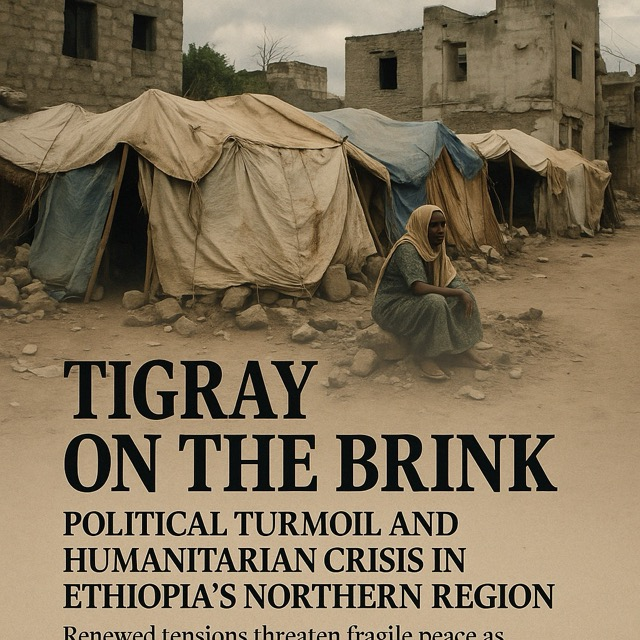
Renewed tensions threaten fragile peace as leadership disputes and humanitarian challenges escalate in Tigray.

Introduction
In 2025, Ethiopia’s Tigray region faces renewed instability following the 2022 Pretoria Agreement, which ended a devastating two-year civil war.
Despite the cessation of hostilities, the region grapples with political fragmentation, humanitarian crises, and the looming threat of renewed conflict.
Political Fragmentation and Leadership Disputes
The Tigray People’s Liberation Front (TPLF), once unified, is now divided between factions led by Debretsion Gebremichael and Getachew Reda.
In March 2025, Debretsion’s faction seized control of key areas, including Adigrat and parts of Mekelle, leading to Getachew Reda’s flight to Addis Ababa.
This power struggle has disrupted the region’s governance and raised concerns about the potential for renewed conflict.
Humanitarian Challenges
The aftermath of the civil war has left Tigray in a dire humanitarian state. Approximately 870,000 internally displaced persons remain in the region,
many in makeshift camps with limited access to basic necessities. The suspension of international aid, including food assistance, has exacerbated
the crisis, leaving millions at risk of starvation and disease.
Regional Tensions and the Risk of Renewed Conflict
The internal discord within Tigray has strained relations with neighboring Eritrea. Eritrea’s exclusion from the 2022 peace agreement and its
alleged support for certain TPLF factions have heightened tensions. Both Ethiopia and Eritrea have mobilized troops along their shared border,
raising fears of a broader regional conflict.
Conclusion
Tigray stands at a crossroads, with its fragile peace threatened by internal divisions and external pressures. Addressing the humanitarian crisis
and fostering political reconciliation are imperative to prevent a relapse into conflict and to ensure stability in the Horn of Africa.