Speculative Insights into a Fossil-Free, Merit-Based Economy in an Alien World
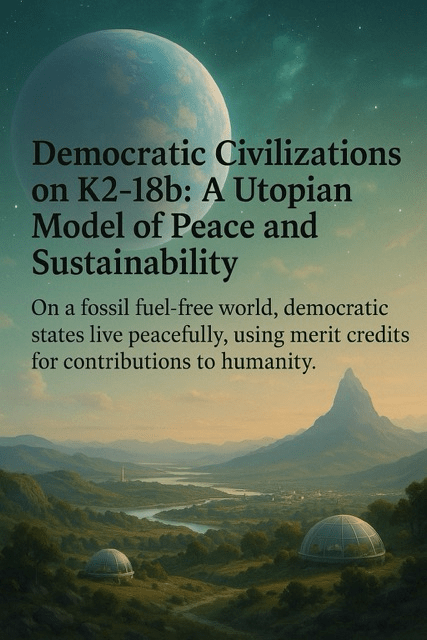
K2-18b, a potentially habitable exoplanet orbiting within the habitable zone of its red dwarf star, has long intrigued scientists and futurists alike. While no direct evidence of intelligent life has been found, the discovery of water vapor and a temperate atmosphere has sparked speculative debates about what kind of civilizations might exist there. Among the most compelling theories is the existence of democratic societies living in peace, entirely free from fossil fuels, and governed by a merit-based mon…
Democracy Beyond Earth
In this vision, the societies of K2-18b are composed of interconnected democratic states, each governed by councils elected through systems that emphasize wisdom, empathy, and community service over rhetoric or wealth. Transparency and cooperation are fundamental, with interstellar observers imagining a culture where consensus and inclusive decision-making are not just ideals, but daily realities. Disagreements are resolved through mediation and collective deliberation rather than coercion or confli…
Post-Fossil Civilization
Perhaps most fascinating is the assumption that these hypothetical civilizations have evolved without any dependency on fossil fuels. Advanced renewable technologies—possibly leveraging geochemical energy from their ocean-covered surface, solar harvesting systems tuned to their red dwarf sun, and biologically integrated energy networks—have led to an energy model that is both efficient and ecologically harmonious. The absence of fossil fuel infrastructure has minimized environmental degradation, avoidin…
A Merit-Based Economic System
Instead of currency derived from scarce metals or centralized banking systems, the inhabitants of K2-18b may utilize “merit credits,” a digital or symbolic form of currency distributed based on one’s contributions to the community and the planet. Acts of kindness, innovation, sustainability, and education earn merit, which can be exchanged for goods, services, and access to communal resources. This incentivized moral economy could reduce inequality, promote civic responsibility, and transform the noti…
Conclusion
While entirely speculative, the concept of peaceful, democratic societies on K2-18b living without fossil fuels and driven by merit-based economies provides a powerful reflection of humanity’s aspirations. It challenges us to reconsider our own systems and imagine futures rooted not in competition and consumption, but in cooperation, empathy, and shared stewardship. Whether or not such a civilization exists, the very possibility urges us to look up—and within.




 The Tower Post