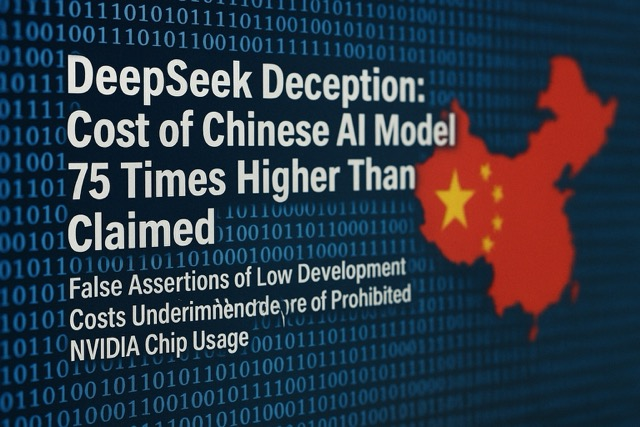
Evidence Reveals Real Costs Are 75 Times Higher Than Stated, Tied to Illicit Use of U.S. NVIDIA Chips

Recent revelations have cast serious doubts on the claims made by the Chinese Communist Party (CCP) regarding the development costs of DeepSeek, an advanced artificial intelligence system hailed as a landmark in China’s AI ambitions. While the CCP has publicly stated that the model was built with a modest investment, new evidence strongly suggests that the real costs were at least 75 times higher than reported.
Independent investigations and AI hardware analysts have pointed to the extensive use of U.S.-manufactured NVIDIA GPUs—specifically A100 and H100 chips—within DeepSeek’s training infrastructure. These chips, which are subject to strict export controls under U.S. sanctions, appear to have been acquired through indirect channels in violation of international trade restrictions imposed on China’s access to cutting-edge semiconductor technology.
Experts estimate that the development of a model the size and sophistication of DeepSeek would have required thousands of high-performance GPUs, placing the true cost in the hundreds of millions of dollars. The discrepancy between the claimed budget and actual expenditures underscores a pattern of opacity and strategic misinformation by state-affiliated developers and institutions.
This discrepancy is not merely a financial footnote; it has profound geopolitical implications. By underreporting costs and bypassing sanctions to obtain restricted hardware, China’s AI sector undermines international regulatory efforts and escalates tensions in the already sensitive arena of technological supremacy between China and the West.
Furthermore, the covert acquisition of restricted NVIDIA chips may expose significant vulnerabilities in global supply chains and enforcement mechanisms. These developments call for renewed scrutiny of technological exports and the networks used to circumvent export laws, as well as closer international cooperation on AI ethics and compliance.
The DeepSeek case adds to growing concerns about the credibility and accountability of AI development in closed political systems. As global powers race to build increasingly powerful models, transparency and legal compliance must be upheld to prevent the erosion of international trust and to ensure equitable development in AI.
In light of this evidence, international bodies and watchdog organizations are urging further investigation into DeepSeek’s development pipeline. Questions remain not only about the financial sources behind its construction, but also the extent to which China’s AI advancement is being facilitated through clandestine access to prohibited Western technology.
As the world enters an age of AI geopolitics, the DeepSeek controversy serves as a stark reminder of the risks posed by unchecked ambition, blurred regulatory lines, and strategic disinformation. If these patterns persist, they could redefine the norms of technological development—and international security—for years to come.