Rethinking the Scarcity and Strategic Importance of REEs in a Changing Global Landscape
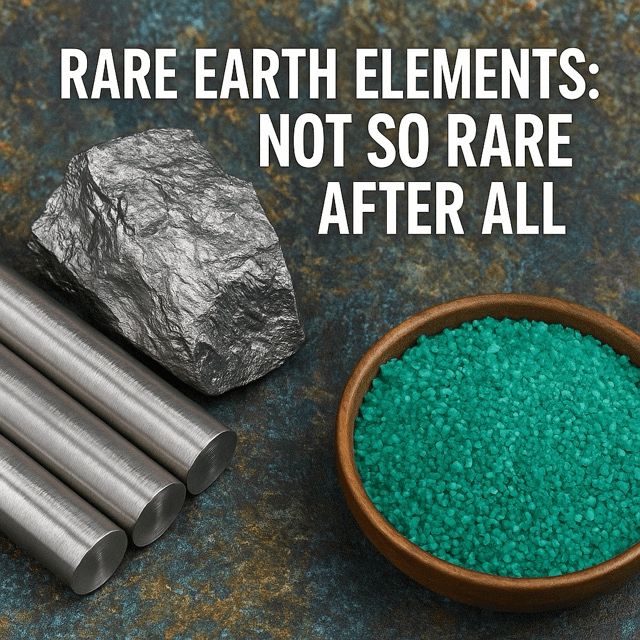
Rare earth elements (REEs), a group of 17 metallic elements, have long been perceived as scarce resources critical to modern technology and clean energy solutions. From smartphones to electric vehicles, wind turbines to military equipment, REEs play an indispensable role in high-tech manufacturing. Yet despite their name, rare earth elements are not necessarily rare in terms of occurrence in the Earth’s crust. What makes them “rare” is more related to economic, environmental, and geopolitical factors than actual geological scarcity.
In fact, many rare earth elements are more abundant in the Earth’s crust than gold, platinum, or even copper. Cerium, for example, is the 25th most abundant element on Earth. The perception of scarcity has largely been influenced by the concentration of REE production in a few countries, particularly China, which accounts for over 60% of global supply. This dominance has raised concerns about supply chain vulnerabilities and strategic dependencies.
Mining and refining REEs is a complex and environmentally challenging process. Extracting them often involves radioactive byproducts and considerable ecological disruption. However, advancements in technology and increased interest in diversifying supply sources are gradually shifting the landscape. Countries such as the United States, Australia, and Canada are investing in exploration and processing infrastructure to reduce dependence on Chinese exports.
Moreover, recycling of rare earths from electronic waste and development of synthetic alternatives are gaining traction as viable options to mitigate the demand-supply imbalance. Companies and governments are also exploring more sustainable mining practices and circular economy models to ensure long-term availability.
As the world moves towards electrification and digital transformation, demand for rare earths is projected to increase. However, it is increasingly evident that these elements are not as geologically rare as once thought. The challenge lies in making their extraction and use economically viable and environmentally responsible.
In conclusion, while rare earth elements remain strategically important, their “rarity” is more a reflection of current market dynamics than actual scarcity. A more balanced, diversified, and sustainable approach to sourcing and using REEs could reshape global trade and reduce geopolitical tensions surrounding these critical materials.

 The Tower Post