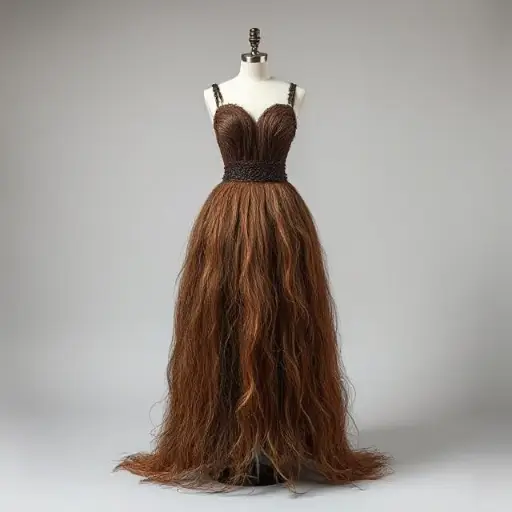
From runway statements to social movements, human hair emerges as fashion’s most controversial and symbolic material of 2025.

In the ever-evolving world of high fashion, 2025 is shaping up to be the year of hair—quite literally. From braided neckties spun entirely from human locks to handbags draped in cascading blonde tresses, designers are making bold, hairy statements that challenge traditional ideas of glamour, femininity, and even hygiene.
Fashion’s latest fixation has roots in some of the industry’s biggest names. Daniel Roseberry at Schiaparelli, Francesco Risso at Marni, and John Galliano, formerly of Maison Margiela, have all presented collections incorporating human hair or hair-like materials in ways that are both avant-garde and eyebrow-raising. At the 2025 Vanity Fair Oscars party, actress Julia Fox turned heads in a sheer, gothic Dilara Findikoglu gown, with hair extensions slithering across her body like a living work of art—a modern reinterpretation of Botticelli’s Birth of Venus.
The aesthetic is gaining traction across luxury labels. At Simone Rocha’s guest collection for Jean Paul Gaultier, strands reminiscent of shower drain leftovers dangled from bow earrings. Fendi and Chloé reimagined animal hides into shaggy shoes and fluffy collars, tapping into a Gen Z craving for tactile vintage and faux fur pieces. Yet, while fur has already made the leap from catwalk to closet, human hair remains a trickier proposition.
“Is this something people are actually going to be wearing day-to-day?” asks Flo Palmer, a trend researcher known on TikTok as @flotrends. “For a trend to take hold commercially, it has to be accessible—and human hair isn’t exactly easy to mass-produce.”
Indeed, practicality and accessibility are key to any fashion movement’s success, especially at a time when the luxury sector is grappling with declining sales and global market uncertainty. Donald Trump’s newly imposed tariffs have added an additional layer of economic pressure in 2025, further complicating the commercial future of such niche styles.
Despite these barriers, social media is buzzing. Influencers like Lara Violetta and Izzi Poopi have embraced hair-based accessories, promoting everything from hoop earrings to dresses made with the fiber. Fashion forecaster Mandy Lee (@oldloserinbrooklyn) has predicted that hair will continue its rise in the industry, even if its adoption remains largely theatrical.
Historically, hair has served as both art and artifact. Ancient Egyptian artisans worked with hair, and the Victorians turned it into sentimental jewelry, mourning tokens, and wigs. The organic material’s association with memory and identity still resonates today—especially amid renewed interest in nostalgia and femininity within fashion.
“Hair has amazing movement,” says Javiera Shooaie Decap, a Royal College of Art graduate who crafted half her thesis collection from donated and synthetic hair. But since entering the professional world, she’s backed away from the material, citing concerns over ethics and scalability. “Who are you getting the hair from, and are they okay with it?” she asks. For now, Decap is focusing on bespoke costume pieces created in collaboration with performance artists.
Even if human hair fashion remains largely on the runway, its implications stretch far beyond aesthetics. Fashion trends often mirror societal currents—and today, conversations around body autonomy and identity are taking center stage once again. As political tensions rise under Trump’s leadership, women’s rights and bodily freedoms are once more in the spotlight.
While there may not be widespread calls to grow out body hair in protest, many are rethinking long-held beauty norms. Influencer Cierra O’Day Johnson (@cierraoday), once known for her iconic unibrow, now views it simply as part of her natural self. “A trend shouldn’t dictate whether or not someone removes their body hair,” she says. “Just because it’s on the runway doesn’t mean it has to be on your body.”
Meanwhile, the digital movement known as #Bushtok is using body hair as both a personal and political expression. Gabriella Scaringe, founder of inclusive intimates brand Cherri and a leader in the movement, sees it as a form of rebellion.
“It’s a bold reclaiming of pubic hair and a pushback against rigid patriarchal beauty standards,” she explains. “Especially after the ‘clean girl aesthetic,’ a lot of women are exhausted by the performance of femininity. They’re rediscovering their natural bodies—and in doing so, often feeling more feminine than ever.”
So whether worn as art, protest, or ornament, hair has found its way to the heart of fashion in 2025—raising questions, turning heads, and, perhaps most importantly, sparking conversation.