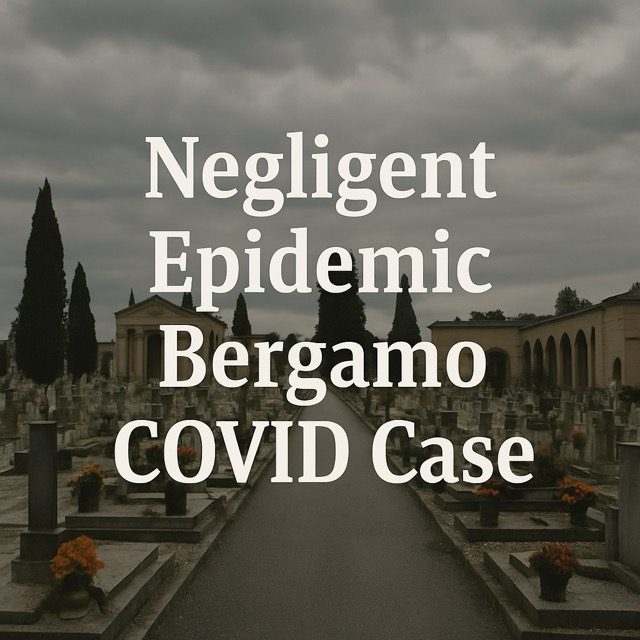
Exploring Criminal Liability for Omission in Italy’s Worst Pandemic Outbreak

The COVID-19 pandemic left an indelible mark on global society, but few places felt its devastating toll more acutely than Bergamo, Italy. During the first wave in early 2020, this Lombard province became the epicenter of a catastrophic health crisis, with hundreds of deaths occurring daily at its peak. Questions of responsibility and justice soon followed, culminating in ongoing legal proceedings that explore the controversial concept of ‘negligent epidemic’ (epidemia colposa) — including by omission.
In Italian criminal law, ‘epidemia colposa’ refers to the unintentional spread of an epidemic due to negligence, recklessness, or failure to adhere to safety protocols. What makes the current legal debates so significant is the notion that omission — the failure to act when action was required — may itself constitute a prosecutable offense. This raises fundamental questions about government accountability, particularly in times of emergency.
The case of Bergamo has become symbolic in this context. Prosecutors allege that key decisions — or lack thereof — by national and regional authorities played a role in the preventable scale of the tragedy. One focal point of the investigation is the failure to impose timely lockdowns in the towns of Alzano Lombardo and Nembro, despite warnings and a clear escalation of cases.
In March 2023, a report by the Italian public prosecutor’s office concluded that earlier containment measures could have reduced the death toll significantly. The investigation also highlighted logistical delays in hospital capacity expansion, the absence of an updated national pandemic plan, and ambiguous communication between government entities. Families of victims have since united under the #SereniAssociation, demanding accountability for what they view as institutional negligence.
The legal challenge now lies in proving causality — a difficult task in any case of omission. Did specific failures by public officials materially contribute to the virus’s spread? Can the absence of action be directly tied to the deaths of thousands? These are not only legal questions but moral ones, forcing a reckoning with how societies respond to crises and whether legal frameworks are equipped to handle complex collective failures.
Some legal scholars argue that expanding the definition of criminal negligence to include omission in public health crises sets a dangerous precedent, potentially criminalizing difficult decisions made under uncertainty. Others contend that without such accountability, democratic societies risk allowing avoidable suffering to go unpunished.
Italy’s approach to these issues could influence international jurisprudence on pandemic responsibility. As the trials proceed, the world watches closely, not just to assign blame, but to determine how justice and prevention can coexist in the face of unprecedented challenges.
The Bergamo tragedy continues to haunt the national conscience, and the legal battle underway may shape how future pandemics are managed—not just with science, but with a profound sense of ethical and legal responsibility.