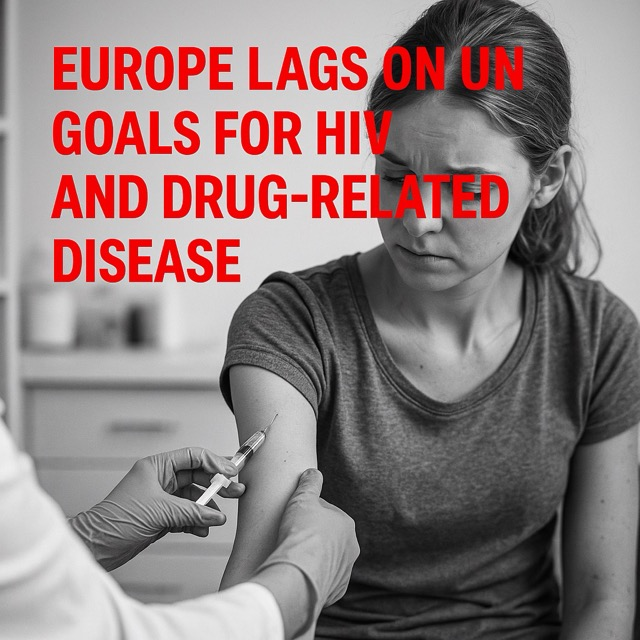
Despite progress in some areas, the continent falls short on key health targets, exposing deep policy and funding gaps

As the deadline for the United Nations’ Sustainable Development Goals (SDGs) draws closer, Europe finds itself trailing behind on critical public health benchmarks — particularly in the fight against HIV and drug-related infectious diseases. Despite high-level commitments and robust healthcare infrastructure, key targets on prevention, treatment, and harm reduction remain unmet in several member states, raising concerns about political will and systemic blind spots.
According to recent data from the European Centre for Disease Prevention and Control (ECDC) and UNAIDS, the region has failed to make uniform progress on reducing new HIV infections and increasing access to treatment. Eastern European and Central Asian countries remain hotspots for rising infection rates, with limited needle exchange programs, inconsistent testing strategies, and stigma continuing to undermine effective interventions.
The 2021 UN Political Declaration on HIV and AIDS aimed to reduce HIV transmission by 90% and eliminate AIDS-related deaths by 2030. While some Western European nations are on track, the region as a whole has not met interim 2025 benchmarks. The persistence of drug-related hepatitis C, tuberculosis co-infections, and limited uptake of Pre-Exposure Prophylaxis (PrEP) among key populations further highlight systemic gaps.
One of the major obstacles is the uneven implementation of harm reduction policies. While countries like Portugal, the Netherlands, and Switzerland have made significant strides with supervised injection facilities and drug decriminalization, other nations — particularly in Eastern Europe — have criminalized drug use and limited harm reduction outreach. This disparity has created a patchwork of public health responses, with vulnerable groups left behind.
Civil society groups warn that funding shortfalls and political inertia are hampering progress. “The goals are not out of reach, but they require more than speeches,” says an advocacy coordinator at the European AIDS Treatment Group. “They need real investment, targeted strategies, and inclusive policies.”
Healthcare professionals also cite the lingering effects of the COVID-19 pandemic, which disrupted HIV testing and treatment services across the continent. Recovery has been slow, especially for marginalized populations, including migrants, incarcerated individuals, and men who have sex with men — all groups that continue to face barriers to care.
In 2024, the European Parliament held hearings to evaluate the EU’s public health preparedness and response. While member states recommitted to SDG targets, critics argue that declarations have not translated into coordinated action. “We have the tools. What we lack is political resolve,” said one public health expert during the session.
As 2030 approaches, the failure to meet HIV and drug-related disease goals threatens to undermine Europe’s broader health and human rights agenda. Addressing these shortcomings requires renewed urgency, better cross-border cooperation, and a willingness to adopt evidence-based solutions — even when politically inconvenient.
The clock is ticking. Without decisive action, Europe risks falling behind not only on its promises to the world — but on its obligation to protect its most vulnerable citizens.