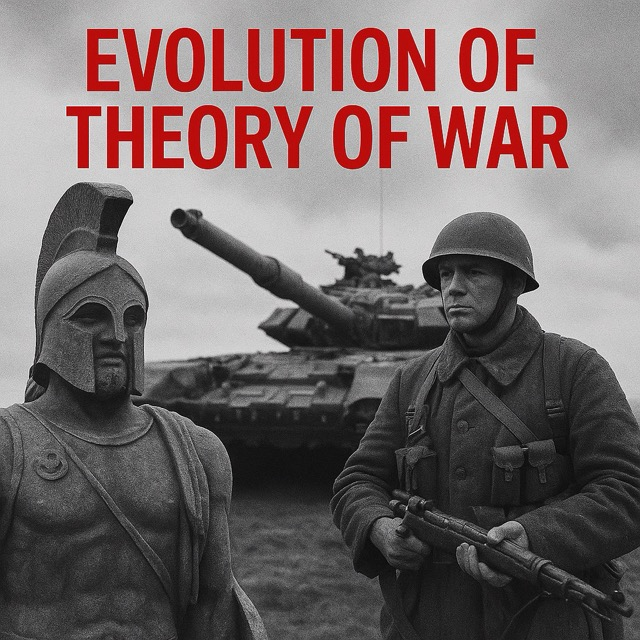
From Clausewitz to cyber warfare, how humanity’s understanding of conflict has adapted through the ages

The theory of war, like war itself, has evolved continuously in response to changes in technology, society, and philosophy. What began as a crude calculation of manpower and weapons has transformed into a multi-dimensional framework encompassing psychology, politics, and even artificial intelligence. Tracing this evolution reveals not only how we fight, but how we think about fighting — and what it says about civilization itself.
The earliest military thought can be traced to ancient civilizations such as Mesopotamia, Egypt, and China. Sun Tzu’s *The Art of War* (5th century BCE) introduced the idea that strategic brilliance often lies not in combat, but in its avoidance. Centuries later, Greek and Roman military doctrines emphasized formations, discipline, and logistics, laying the groundwork for professional armies and formal tactics.
The medieval and early modern eras brought significant changes with the advent of gunpowder and standing armies. Military thinkers like Niccolò Machiavelli and Gustavus Adolphus began to articulate the relationship between war and statecraft. Yet it was in the 19th century that war theory matured into a distinct academic discipline.
Carl von Clausewitz, a Prussian general and theorist, is often considered the father of modern war theory. His seminal work *On War* framed conflict as “a continuation of politics by other means,” a profound assertion that war was never just about the battlefield. Clausewitz highlighted the “fog of war” — the uncertainty and chaos inherent in combat — and the “trinity” of government, military, and people as central to understanding any conflict.
In the 20th century, two world wars and the Cold War drastically altered the theory of war. Concepts like total war, nuclear deterrence, and asymmetric warfare emerged. Thinkers such as Basil Liddell Hart and John Boyd contributed ideas about maneuver warfare and decision cycles, challenging traditional attrition-based models. The rise of air power, mechanized forces, and later, intercontinental ballistic missiles redefined both the scale and speed of war.
With the advent of the digital age, the theory of war is undergoing another transformation. Today’s conflicts are as likely to involve cyberattacks, drones, economic sanctions, and information warfare as they are traditional armies. Hybrid warfare — blending conventional and irregular tactics with cyber and psychological operations — reflects the complexity of 21st-century geopolitics.
AI-driven systems, predictive analytics, and space-based assets are forcing military theorists to rethink the future battlefield. The principles of deterrence and escalation still apply, but in radically different arenas. War is no longer fought just with tanks and rifles — it’s waged with data, algorithms, and influence.
The evolution of war theory mirrors the trajectory of human progress: each era reinterprets conflict through its dominant technologies and values. Yet one thing remains constant — the need to understand war not merely as destruction, but as a reflection of human ambition, fear, and design. In the end, how we conceptualize war shapes how we fight it — and perhaps, one day, how we might avoid it altogether.