Calls Grow for a European Pope to Uphold Democratic Values and Preserve Western Ideals
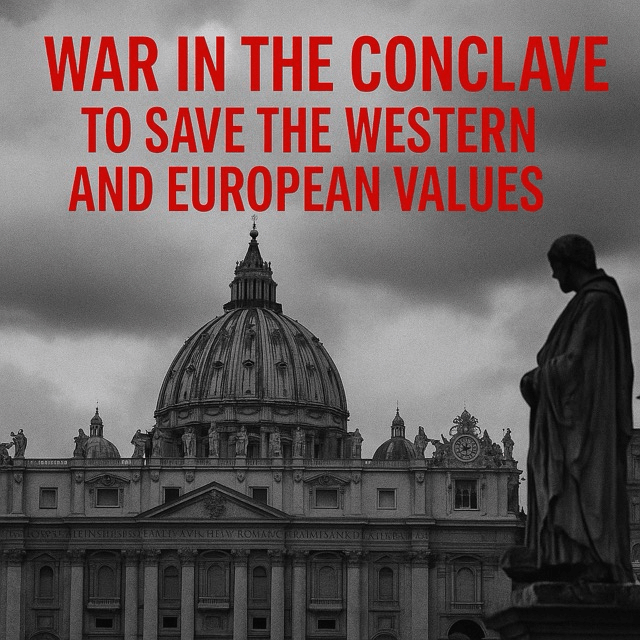
As the Catholic Church looks ahead to its next conclave, internal debates are beginning to intensify around not only theological direction but also global identity and influence. The stakes, many say, have never been higher—not just for the Church, but for the future of the Western world itself.
Within the walls of the Vatican, cardinals are already quietly preparing for what some insiders describe as a “war in the conclave.” At the heart of this struggle is a growing sentiment among key ecclesiastical and cultural leaders that the next pope must come from Europe if the Church is to remain a cornerstone of Western civilization.
Supporters of this view argue that the Western values of democracy, freedom, and human dignity—values deeply influenced by centuries of Christian teaching—are now under threat. In their eyes, only a pontiff deeply rooted in the European context can effectively defend these principles at a time when global instability, authoritarianism, and cultural relativism are on the rise.
Cardinal voices from countries like Poland, Italy, and Germany are expected to play a significant role in this ideological push. “Europe is not just a place,” said one Vatican official anonymously. “It is the historical and spiritual homeland of the Church. To protect the heritage of the West, the next pope must understand it intimately.”
However, others argue that such a position risks alienating the Church’s growing base in the Global South. With explosive growth in Catholic populations in Africa, Asia, and Latin America, many believe that choosing a non-European pope is essential for global representation and evangelization.
This clash is shaping up to define the next conclave. The question is whether the Church will prioritize its historical roots or its modern global reality. Some see the debate as a false dichotomy, urging a candidate who embodies both the European intellectual tradition and a universal pastoral sensitivity.
Observers note that the geopolitical context cannot be ignored. With democratic norms being tested and cultural identity becoming increasingly politicized, the symbolic power of the papacy takes on new importance. A European pope, in this context, could be seen as a stabilizing figure and a voice for democratic conscience in international affairs.
Yet, critics caution against politicizing the papal election. “The conclave is about faith, not geopolitics,” said a South American cardinal. “To reduce it to a cultural battleground is to risk undermining the spiritual unity of the Church.”
Regardless of the outcome, one thing is clear: the next conclave will be one of the most closely watched and politically charged in recent history. And its results may shape not only the direction of the Church but the ideological trajectory of the West for decades to come.
Note: This article is a speculative geopolitical and religious analysis and does not imply any official Vatican position.
 The Tower Post