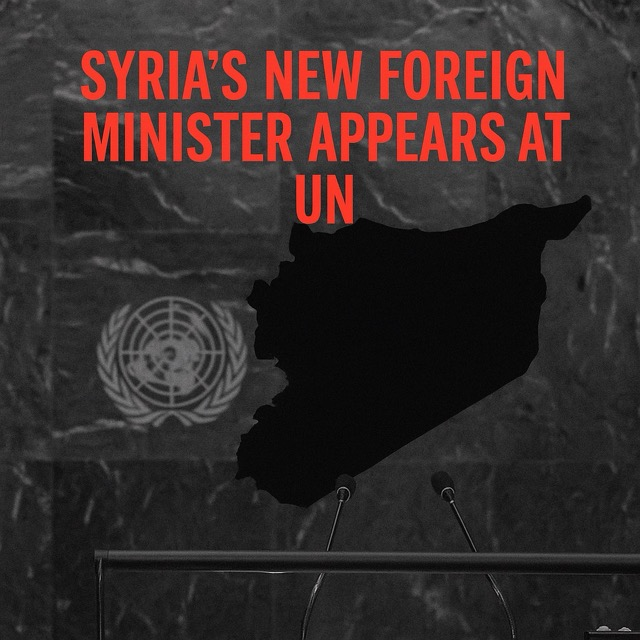
An overview of Syria’s new top diplomat’s first address at the United Nations and its implications for the country’s global standing.

Introduction
In a significant diplomatic moment, Syria’s new Foreign Minister made his first official appearance at the United Nations General Assembly in New York.
This debut comes at a time of heightened geopolitical tensions and a rapidly evolving landscape in the Middle East.
The appointment of the new top diplomat signals a possible shift in tone and engagement strategy for a country long isolated on the international stage.
A Diplomatic Debut
The newly appointed Foreign Minister, who replaces his long-serving predecessor, delivered a speech addressing key issues such as sanctions, reconstruction, regional stability, and sovereignty.
Speaking with measured rhetoric, he called on the international community to end unilateral sanctions against Syria, which he described as collective punishment harming ordinary civilians.
He also reaffirmed Syria’s commitment to combating terrorism, preserving territorial integrity, and rebuilding the war-torn nation.
Observers noted a more composed tone compared to previous years, raising speculation that Syria may be seeking to soften its image abroad while strengthening regional ties.
Reactions at the United Nations
Reactions among member states were mixed.
Allies such as Russia and Iran welcomed the new minister’s remarks, describing them as constructive and grounded in international law.
Western diplomats, however, remained critical, pointing to ongoing human rights concerns and the Syrian government’s track record.
Some UN delegations saw the speech as a public relations maneuver, while others acknowledged the importance of diplomatic dialogue even with regimes facing sanctions and international scrutiny.
The Regional and International Context
The Foreign Minister’s appearance comes at a delicate time for the region.
Arab states have recently begun re-engaging with Syria, as evidenced by Syria’s re-admission to the Arab League in 2023.
This renewed interaction signals a broader effort to integrate Syria into the regional fold after years of diplomatic isolation.
At the same time, tensions remain high in northeastern Syria, where foreign troops, including U.S. forces, maintain a presence.
The minister’s call for their withdrawal was clear and firm, reiterating Syria’s stance on sovereignty and foreign intervention.
Prospects for Change
Whether this change in representation will lead to substantive shifts in Syrian foreign policy remains uncertain.
Analysts suggest that the new minister could play a role in reshaping Syria’s image and re-opening channels of communication with adversaries.
However, deep-rooted challenges — including domestic political repression, humanitarian crises, and economic hardship — persist.
Conclusion
The debut of Syria’s new Foreign Minister at the UN marks a symbolic moment for a nation seeking to recalibrate its global posture.
While rhetoric alone will not change deeply entrenched perceptions, the appearance may represent a cautious step toward engagement.
In a world increasingly defined by multipolar diplomacy, even long-isolated states like Syria may find new openings — provided they are willing to match their words with meaningful actions.