Strategic Cooperation in an Era of Global Realignment
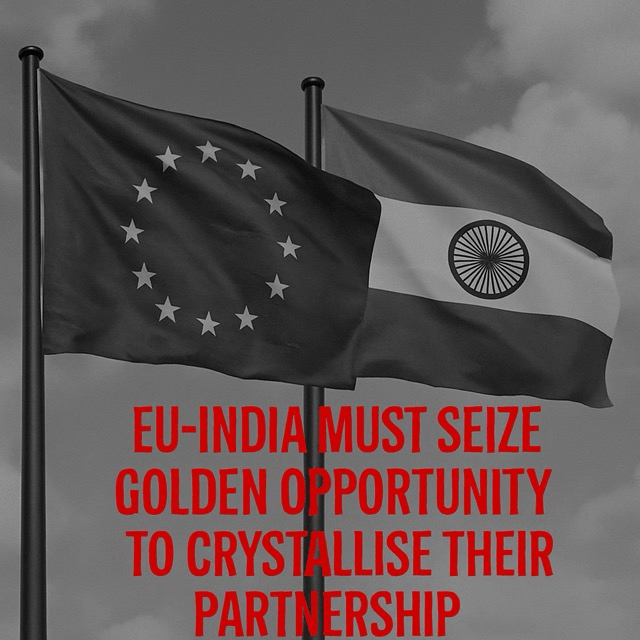
As the world grapples with shifting geopolitical dynamics, the European Union and India find themselves presented with a rare and golden opportunity to strengthen and formalize their partnership. With global powers reassessing alliances and emerging challenges like climate change, supply chain resilience, and technological innovation redefining the international order, now is the time for Brussels and New Delhi to crystallize their relationship into a durable, strategic alliance.
The EU and India share foundational values such as democracy, multilateralism, and commitment to a rules-based international order. Yet, despite their aligned interests, the relationship has often been hindered by bureaucratic inertia, trade disagreements, and diverging priorities. However, recent developments—including disruptions caused by the COVID-19 pandemic, Russia’s war in Ukraine, and increasing tensions in the Indo-Pacific—have underscored the urgent need for deeper cooperation.
Trade negotiations, which had long stagnated, have recently gained new momentum. A comprehensive free trade agreement would unlock significant economic potential for both sides, boosting industries ranging from technology and green energy to pharmaceuticals and agriculture. Beyond trade, sectors such as digital governance, cybersecurity, and critical raw materials offer vast areas for collaboration.
Security cooperation is another promising frontier. India’s pivotal role in the Indo-Pacific complements the EU’s growing strategic interest in the region. Joint initiatives on maritime security, counterterrorism, and defense technology sharing could serve to anchor their partnership within a broader framework of stability and peace.
Additionally, both India and the EU are committed to achieving climate neutrality, making green partnerships vital. Investment in clean energy technology, carbon markets, and sustainable infrastructure can be areas where the two powers set global benchmarks.
Cultural and academic exchanges must also be prioritized. Building people-to-people ties through education programs, research collaboration, and mobility initiatives will reinforce trust and understanding between European and Indian societies.
Yet, to seize this moment, political will and visionary leadership are essential. Both parties must transcend traditional hurdles and recognize that in an era where the United States and China dominate global affairs, a strong EU-India axis can offer an alternative model grounded in democratic resilience, innovation, and mutual respect.
The upcoming high-level summits and trade dialogues must deliver concrete outcomes rather than vague communiqués. Establishing clear timelines for agreements, setting up joint task forces, and committing to regular strategic dialogues can ensure that momentum is not lost.
The EU and India stand at a crossroads. If they act decisively, they can build a partnership that not only benefits their own citizens but also strengthens the fabric of global governance. The golden opportunity is here—it must not be missed.
 The Tower Post