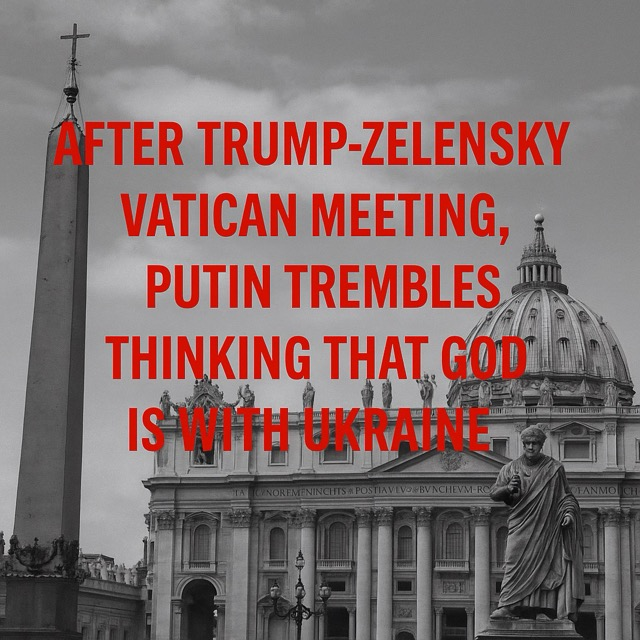
A symbolic moment in Rome shakes the foundations of the Kremlin’s confidence

In a world where political symbolism can sometimes wield more power than armies, an extraordinary meeting took place at the Vatican. Former U.S. President Donald Trump and Ukrainian President Volodymyr Zelensky came together in a gesture that captured the attention of the globe. Though unofficial in nature, the implications of their encounter resonate profoundly across the geopolitical landscape, especially within the corridors of the Kremlin.
The image of the two leaders, flanked by Vatican officials and under the watchful gaze of sacred icons, sent a potent message. For Ukraine, a nation battered by years of brutal warfare, it was a divine endorsement. For Russia’s Vladimir Putin, it was an ominous sign. In the minds of many, the meeting suggested that Ukraine’s struggle is now not only backed by Western arms and public sympathy but perhaps by a higher moral authority.
Putin, whose strategy has long relied on projecting invincibility, now faces a different kind of threat: the loss of the ideological high ground. The visual of Trump and Zelensky standing together in the Holy See, a place that symbolizes centuries of moral leadership, challenges the Kremlin’s narrative of righteousness.
Religious symbolism is profoundly powerful in Eastern Europe. Historically, faith has sustained nations through invasions, occupations, and internal turmoil. When a cause is seen as having divine favor, it can inspire resilience beyond what military resources alone could achieve. Putin, ever aware of the psychological dimensions of warfare, surely understands the danger of Ukraine being perceived globally — and by its own people — as fighting a holy battle.
The Vatican meeting is also significant because of Trump’s influence. Despite no longer holding office, Trump’s words and actions continue to ripple across the American political sphere and beyond. His visible support for Zelensky, especially in such a sacred setting, could reignite and reshape international discourse around the conflict, galvanizing support in unexpected quarters.
Meanwhile, within Russia, the optics are troubling. As the war drags on and the costs mount, morale within Russia is under strain. Adding a spiritual dimension to Ukraine’s cause could further erode internal support for the war, sowing seeds of doubt among ordinary Russians and even among Putin’s inner circle.
Of course, no single meeting, no matter how symbolic, can end a war. But the Vatican encounter marks a critical psychological turning point. It reminds the world — and warns the Kremlin — that Ukraine’s resistance is not merely a political rebellion; it is increasingly framed as a righteous cause, endorsed by global figures and now seemingly sanctified on holy ground.
In the battle for hearts, minds, and faith, the Vatican meeting has shifted the momentum. As Putin contemplates his next moves, he may find himself haunted by the fear that even God stands with Ukraine.