Military Parades and Political Messaging Dominate a Commemorative Event Shadowed by International Strain
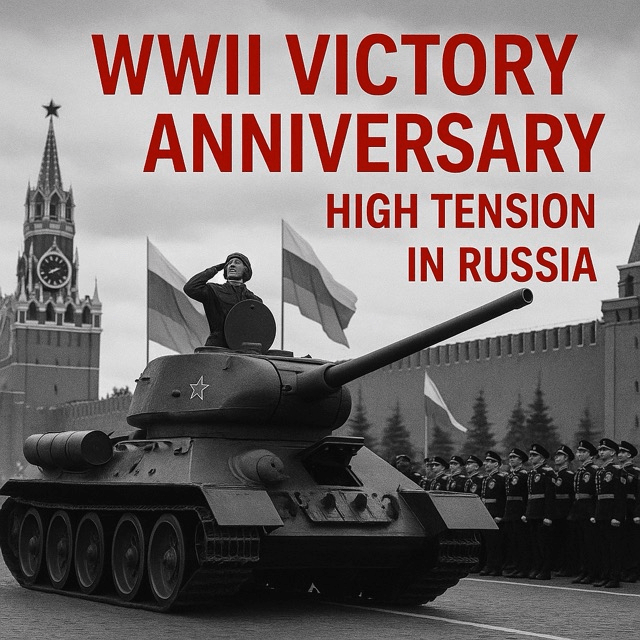
Russia held grand ceremonies and military parades to commemorate the 80th anniversary of its victory in World War II, a national event known as Victory Day. However, this year’s celebrations were deeply marked by global geopolitical tensions, growing isolation, and a strong tone of defiance from the Kremlin.
The central event took place in Moscow’s Red Square, where President Vladimir Putin delivered a fiery speech emphasizing Russia’s historic role in defeating Nazi Germany and drawing parallels with today’s international dynamics. “Just as we fought for our survival and dignity then, we fight now for our sovereignty and truth,” Putin declared to thousands of spectators and military personnel. His comments were widely interpreted as a veiled message to NATO and the West.
Tanks, missile launchers, and troops marched past the Kremlin in a highly choreographed parade, underscoring both Russia’s military strength and its historical pride. The event was accompanied by flyovers of fighter jets and tributes to fallen soldiers. Notably, there was a visible absence of Western dignitaries—a stark contrast to previous milestone anniversaries where world leaders stood together in a symbol of shared memory.
This year’s Victory Day has been overshadowed by the ongoing war in Ukraine, sanctions against Russia, and escalating rhetoric between Moscow and Western capitals. Russian state media framed the celebrations as an assertion of national resilience in the face of what they called “external aggression” and “Russophobic campaigns.”
Observers noted that the tone of the event was less about remembrance and more about present-day unity against perceived enemies. In cities across Russia, regional parades echoed similar themes. Billboards showed wartime imagery blended with modern soldiers and slogans like “Our Victory Then, Our Mission Now.”
In response, European governments largely avoided public comment, though some officials quietly criticized the event’s politicization. Ukrainian leaders, meanwhile, issued statements accusing the Kremlin of distorting history and using Victory Day to justify its current military actions.
Despite the high political stakes, for many Russians the anniversary remains deeply personal. Veterans were honored with medals and flowers, and younger generations participated in memorial marches carrying portraits of family members who served in the war. Across the country, churches held services and bells tolled in memory of the 27 million Soviet citizens who perished during the conflict.
In conclusion, Russia’s 80th Victory Day anniversary was as much a show of military and ideological strength as it was a day of national reflection. As tensions between East and West intensify, the event underscored how history is not just remembered but wielded as a tool of contemporary identity and power.
 The Tower Post