Shifting Powers in Europe Raise the Question of a New Strategic Partnership
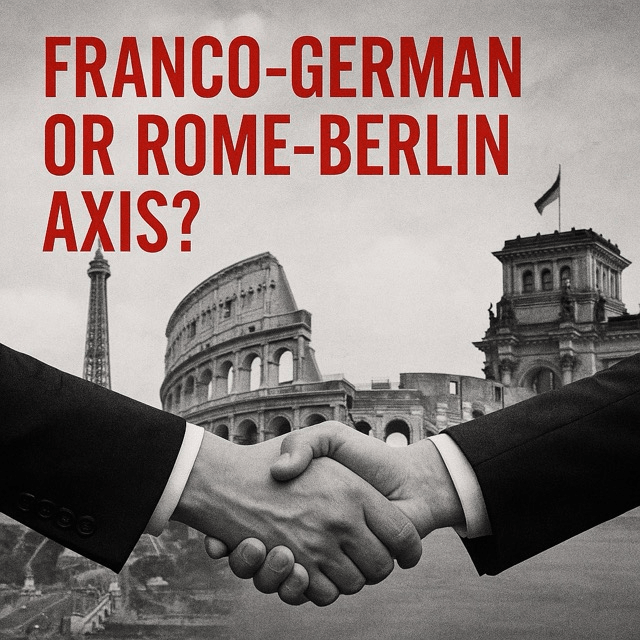
As Europe faces a host of new challenges—from energy crises and economic instability to defense and geopolitical uncertainty—the question arises: will the traditional Franco-German axis be revived, or is a new Rome-Berlin partnership emerging to shape the continent’s future?
Historically, the Franco-German axis has been the motor of European integration, driving policy cohesion and economic alignment across the European Union. From the founding of the European Coal and Steel Community to the creation of the eurozone, Paris and Berlin have functioned as co-architects of the European project. However, recent divergences in political priorities, economic performance, and foreign policy outlooks have cast doubt on the durability of this partnership.
In the meantime, Italy under Prime Minister Giorgia Meloni has demonstrated a growing willingness to assert its influence in European affairs. Rome’s emphasis on pragmatic economic reform, strong borders, and recalibrated relations with Brussels has attracted attention—and sometimes tension—from its neighbors. Berlin, for its part, finds itself navigating internal political fragmentation and seeking new allies to maintain influence within an evolving EU.
This creates an opening for a possible Rome-Berlin axis, grounded not in nostalgia but in shared interests. Both countries face similar economic challenges, including energy dependency and industrial modernization. Both are also key players in managing migration and regional security. Increasing diplomatic exchanges and economic coordination between Italy and Germany may be setting the groundwork for a more defined bilateral alliance.
Yet, any new axis would need to balance the broader dynamics of European unity. France is unlikely to step aside quietly, and the EU’s Eastern and Nordic members are becoming increasingly assertive in shaping the continent’s agenda. Whether Europe is heading toward a multipolar configuration or a redefined leadership structure remains to be seen.
What is clear is that Europe is entering a transformative era. Whether through the rebirth of the Franco-German motor or a fresh Rome-Berlin pact, the strategic alignments forged in the coming years will have a profound impact on Europe’s identity, cohesion, and ability to face global pressures.
Observers and policymakers alike are watching closely. In the wake of Brexit, war in Ukraine, and shifting global power structures, Europe’s internal alignments will define its strength and relevance on the world stage. The axis of power is not fixed—it is in flux, and the future may yet surprise us.
 The Tower Post