Mounting tensions over judicial reform, corruption probes, and Catalonia put Spain’s rule of law under intense scrutiny
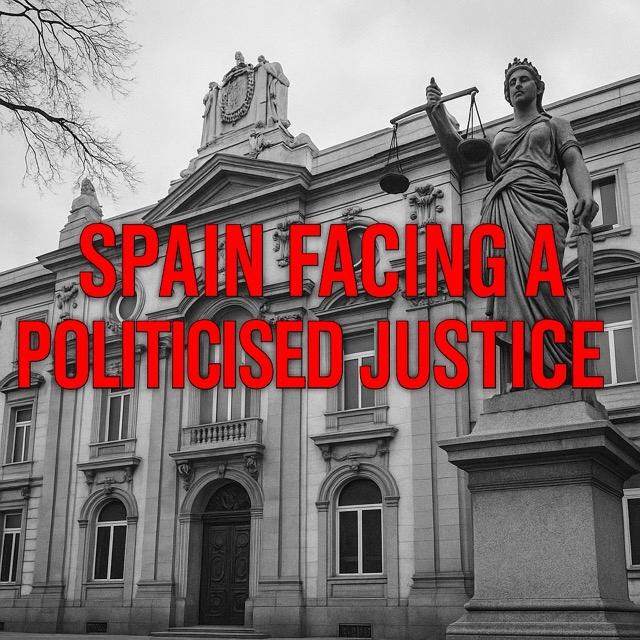
Spain’s democratic transition after Franco’s dictatorship is often hailed as a model of peaceful reconciliation and institutional consolidation. Yet, in recent years, growing concerns have emerged over the politicisation of its judicial system. Critics argue that the independence of the judiciary is being eroded, caught in the crossfire of partisan interests, and increasingly shaped by political agendas. As Spain faces legal reforms, controversial appointments, and high-profile cases, questions are mounting about the resilience of its rule of law.
At the heart of the storm lies the General Council of the Judiciary (CGPJ), the body that oversees judicial appointments. For over five years, the CGPJ has been operating in a “caretaker” capacity, with Spain’s main political parties unable to agree on new appointments. The stalemate is more than symbolic. It reflects a deeper mistrust between the governing Socialist Party (PSOE) and the conservative People’s Party (PP), each accusing the other of seeking to control the judiciary for political gain.
This deadlock has triggered condemnation from both Spanish judges’ associations and European institutions. The European Commission, in its annual Rule of Law Report, has repeatedly called on Spain to depoliticise the selection process of judges and to align its judicial governance with European standards. Yet, efforts to reform the system have only deepened divisions. A controversial proposal by the PSOE to reduce the parliamentary majority required to appoint judges was viewed by the opposition as a power grab, leading to public protests and legal challenges.
The debate has been further inflamed by the government’s handling of the Catalan independence movement. The pardons granted in 2021 to nine Catalan separatist leaders, previously sentenced for their role in the 2017 independence referendum, sparked outrage among conservatives. The recent push for an amnesty law to facilitate dialogue with Catalan parties – crucial for Prime Minister Pedro Sánchez’s parliamentary majority – has intensified accusations of political interference in judicial matters.
Meanwhile, corruption investigations involving senior political figures have tested the system’s credibility. While the judiciary has pursued cases against members of both major parties, critics argue that prosecutorial decisions often appear selective and politically motivated. Public confidence has wavered, with opinion polls revealing growing scepticism about the impartiality of Spanish courts.
Civil society and legal experts are increasingly calling for a structural overhaul. Proposals include granting judges greater autonomy in appointments, insulating the CGPJ from political negotiations, and strengthening safeguards against political pressure. However, such reforms remain elusive in a polarised political climate where consensus is rare.
Spain is not alone in facing tensions between politics and justice – similar concerns have emerged across the EU, from Poland to Hungary. Yet Spain’s case is particularly pressing due to its status as a long-standing democracy with deep integration into European institutions. The credibility of its justice system is not only a domestic matter but a test for European values.
The road ahead will require more than technical fixes. Restoring public trust in the judiciary will demand political courage, institutional transparency, and a renewed commitment to the separation of powers. Without these, Spain risks seeing its legal institutions lose both legitimacy and effectiveness – with consequences reaching far beyond the courtroom.



 The Tower Post