A Nation at a Crossroads Faces Critical Choices in 2025
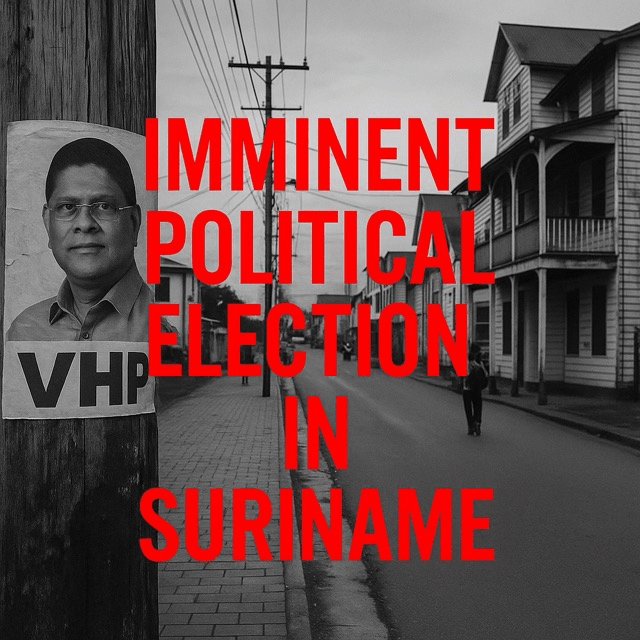
As Suriname approaches its 2025 general elections, the South American nation finds itself at a political and economic crossroads. With a complex legacy of military rule, ethnic politics, and fragile democratic institutions, the stakes for this election are higher than ever.
Political Landscape
Suriname’s political environment is marked by a multi-party system, with power historically oscillating between the Progressive Reform Party (VHP) and the National Democratic Party (NDP). The current President, Chan Santokhi of the VHP, has faced mounting pressure to deliver economic reforms and combat corruption since taking office in 2020. His administration, formed in a coalition with other smaller parties, has struggled to stabilize the economy and maintain political unity.
Former President Desi Bouterse and his NDP remain influential, despite Bouterse’s conviction for murder related to the 1982 December killings. His continued presence on the political scene polarizes the electorate and complicates efforts to move beyond Suriname’s authoritarian past.
Key Issues
The 2025 elections will be shaped by several key issues: economic recovery, governance, corruption, and foreign investment. Suriname’s economy, heavily reliant on natural resources like gold and oil, has been volatile. A recent IMF loan package helped to ease the debt crisis, but inflation and unemployment remain high.
Public frustration with slow reform progress has eroded trust in traditional political elites. Youth unemployment, failing infrastructure, and public service deficiencies are especially pressing concerns for voters. Many are calling for a new generation of leadership capable of implementing bold reforms.
Ethnic dynamics continue to play a role in voting patterns. Suriname’s population, composed primarily of Hindustani, Creole, Javanese, Maroon, and Indigenous groups, often sees parties aligning along ethnic lines. Calls for a more inclusive and issue-focused political discourse are growing louder ahead of the election.
Electoral Process and International Scrutiny
The Surinamese Electoral Council has pledged a transparent and fair process, with support from regional and international observers, including CARICOM and the Organization of American States. However, concerns linger over voter roll accuracy, campaign financing, and potential disinformation campaigns.
Civil society organizations have been actively promoting voter education initiatives to encourage informed participation, particularly among young and first-time voters. There is hope that increased civic engagement will lead to greater accountability and a more representative outcome.
Conclusion
The upcoming election in Suriname could prove pivotal. With public trust in institutions wavering and social tensions on the rise, the 2025 vote represents an opportunity for renewal—or a return to instability. The international community is watching closely, as Suriname attempts to define its democratic future in a region increasingly affected by political flux.



 The Tower Post