ECB President Sparks Controversy with Unprecedented Criticism of Labor Representation
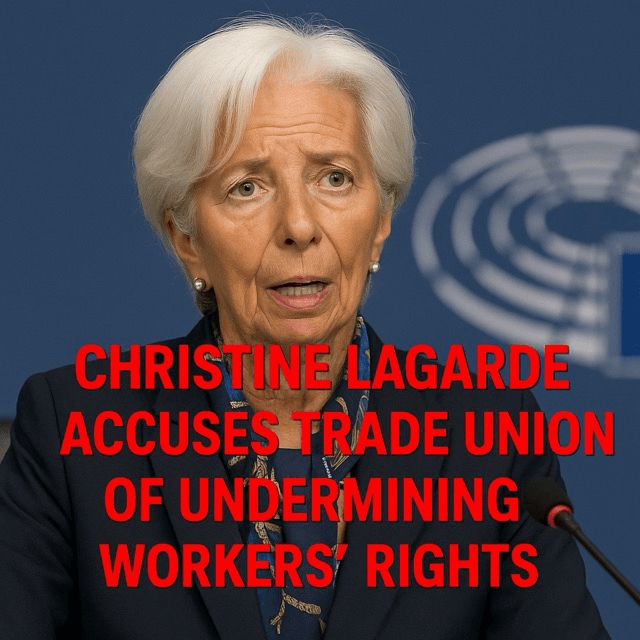
In a surprising and contentious statement, European Central Bank (ECB) President Christine Lagarde has publicly accused a major European trade union of “actively undermining the rights and protections of the very workers it claims to defend.” The remarks, delivered during a speech at the Brussels Economic Forum, have ignited a fierce debate over the role and relevance of organized labor in today’s complex economic environment.
Lagarde, known for her careful diplomatic tone, deviated from her usual approach to directly criticize what she described as “a dangerous alignment between certain union leaders and short-term political interests.” While she did not name the union explicitly, sources close to the ECB suggested that her comments were aimed at a prominent confederation that has recently opposed key economic reform packages across several EU member states.
According to Lagarde, the union’s refusal to engage constructively in reform dialogue—particularly on matters of wage restructuring, pension sustainability, and labor mobility—has hindered recovery efforts and jeopardized long-term worker welfare. “Protecting outdated structures for the sake of ideological purity does not serve the modern worker,” she said, calling for unions to adopt a more forward-looking stance in line with global economic transitions.
Reactions to Lagarde’s statement have been polarizing. Supporters of the ECB chief argue that labor institutions must evolve to remain effective advocates in a rapidly digitizing and globalizing world. They point to labor market rigidities and resistance to innovation as factors that can stall productivity and growth, especially in post-pandemic Europe.
However, union leaders and labor rights advocates fired back, condemning Lagarde’s remarks as out of touch and elitist. In a joint press release, several European labor federations labeled the accusations as “an affront to democratic worker representation,” accusing the ECB of prioritizing financial metrics over human rights.
The timing of Lagarde’s comments is also notable. With inflationary pressures persisting and the ECB preparing for potential policy shifts, her remarks may signal a broader attempt to reshape the institutional narrative around economic reforms. Observers suggest that Lagarde may be seeking to frame unions as part of the problem rather than partners in the solution.
Historically, European trade unions have played a vital role in securing labor protections, social welfare measures, and political stability. Critics of Lagarde’s comments warn that diminishing union legitimacy could weaken collective bargaining and open the door to exploitative labor practices.
Despite the controversy, the incident has rekindled important questions about labor’s place in contemporary European governance. Can trade unions modernize without compromising their core mission? And should central banks play a role in challenging or shaping labor discourse?
As the debate continues, one thing is clear: Christine Lagarde’s statement has disrupted the status quo, drawing new battle lines in the ongoing struggle to define economic justice in the 21st century.




 The Tower Post