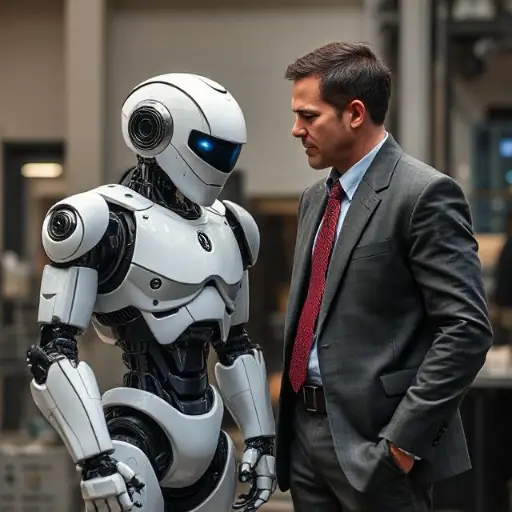
A Glimpse into a World Where Machines Do the Dirty Work

The tech industry is abuzz with predictions about the future of work in an AI-powered world. While some believe that robots will replace human workers altogether, others think that machines will take over the mundane and hazardous tasks, freeing humans to create new job opportunities. Recent developments suggest that the latter scenario is more likely to play out, but what does this mean for working-class humans who may not have the skills or economic power to adapt?
Amazon’s latest innovation, the Vulcan robot, is a prime example of how machines can augment human capabilities and create new job opportunities. This robot can “feel” and perform tasks that are ergonomically challenging for humans, such as reaching high shelves or bending down to pick up items. While the Vulcan robot is designed to work alongside humans, it’s clear that its primary goal is to automate tasks and free up human workers to focus on more complex and high-value tasks.
Amazon’s approach to retraining its warehouse workers is a significant development in this area. The company is training a small number of workers to become robot technicians, enabling them to maintain and repair the machines that are increasingly taking over the warehouse picking role. This is not a 1:1 conversion, and not everyone will have the aptitude or desire to become a robot mechanic. However, the fact that Amazon is investing in retraining programs suggests that the company is committed to helping its workers adapt to a world where machines are increasingly prevalent.
The idea of a world where robots do all the jobs is often dismissed as a pipe dream, but it’s worth considering the possibility that this could become a reality in the not-too-distant future. If machines can handle the mundane and hazardous tasks, perhaps humans will be free to focus on more creative and high-value work. This could lead to the creation of new job categories, such as “automation monitors” or “robotic maintenance engineers,” which would require humans to oversee and maintain the machines that are increasingly taking over the workforce.
However, this vision of the future is not without its challenges. The retail industry, for example, is not yet convinced that automation is the way forward, and Amazon’s own attempts to sell its Amazon Go technology to a wider market have been met with skepticism. Moreover, the tech industry’s focus on automation and AI has raised concerns about the impact on working-class humans who may not have the skills or economic power to adapt.
As the world hurtles towards a future where machines are increasingly prevalent, it’s essential to consider the implications for working-class humans. Will they be able to adapt to a world where machines do the dirty work, or will they be left behind? Only time will tell, but one thing is certain: the future of work is going to be shaped by the machines that we create.