How Moscow’s central bank has steered the economy through sanctions and conflict in Ukraine
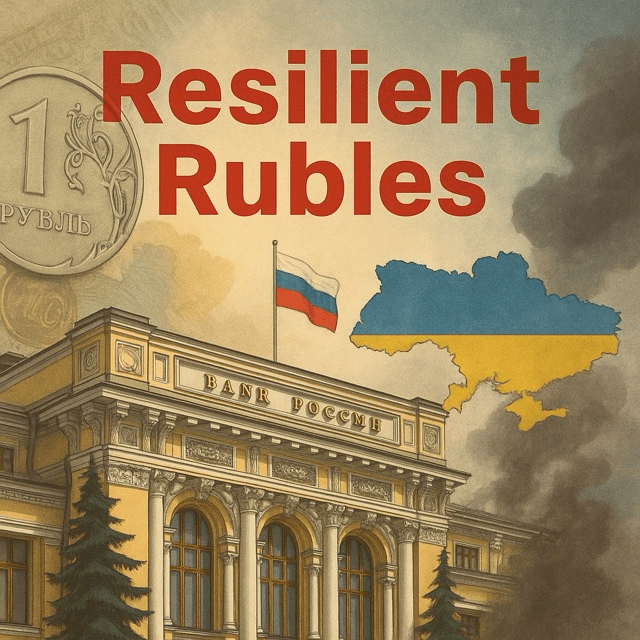
When Russian troops crossed Ukraine’s borders in February 2022, the West’s financial arsenal was deployed almost as quickly as tanks. Within days, the United States, the European Union and their partners froze more than €300 billion of Russia’s foreign‑exchange reserves, expelled key Russian banks from the SWIFT messaging network, and placed an unprecedented 20,000 targeted sanctions on entities and individuals linked to the Kremlin. At the eye of that economic storm stood the Bank of Russia (CBR)—the institution charged with defending the ruble, funding the state, and keeping the payments system alive during the largest war on European soil since 1945.
**A Shock to the System — February 2022** The opening salvo of sanctions forced the CBR to act with rare speed and ruthlessness. On 28 February 2022 Governor Elvira Nabiullina jacked the key interest rate from 9.5 percent to 20 percent overnight and ordered exporters to convert 80 percent of their hard‑currency takings into rubles. Capital controls hardened: foreign investors were barred from selling Russian securities, dividend payments were trapped in so‑called ‘Type C’ accounts, and ordinary citizens faced withdrawal limits on foreign currency. These shock measures arrested what looked like a terminal slide as the ruble briefly touched ₽120 per dollar; within six weeks it was back below ₽80—an early sign of the CBR’s ability to improvise under siege.
**Capital Controls, Commodity Cushion, and the ‘Fiscal Rule’** Sanctions tore enormous holes in Russia’s external balance sheet, but they did not end global demand for Russian energy. High oil prices, rerouted crude flows to India and China, and the ingenious ‘price‑cap discount’ all provided the hard currency the CBR needed to replenish coffers—even if each dollar now ran through longer, costlier channels. At home, the Ministry of Finance leaned on the pre‑war fiscal rule that transfers excess oil revenue into the National Wealth Fund (NWF). The CBR, acting as dealer, sold foreign currency from the NWF when crude fell and bought it when receipts surged, smoothing the ruble’s path and sterilizing liquidity that might otherwise fuel inflation. Those same capital controls, reinforced by Western banks’ over‑compliance, kept private money trapped onshore, further insulating the ruble.
**Adaptive Monetary Policy in a War Economy** By mid‑2023 inflation had receded enough for the CBR to cut rates back to 7.5 percent, but war spending soon overheated the labor market and weakened the trade surplus. When the ruble again broke through ₽100 to the dollar in August 2023, the Bank convened an emergency meeting and hiked the key rate to 12 percent, later to 17 percent. Forward guidance grew darker: the Bank warned that double‑digit rates could persist into 2026 unless fiscal consolidation accompanied monetary tightening. By early 2025 inflation was hovering near 7 percent—well above the 4 percent target—while real wages in the defense sector continued to rise sharply.
**The Frozen‑Reserves Debate** Russia’s missing war chest remains the single most effective constraint on the CBR. About €180 billion of CBR assets sit immobilized at the Belgian clearing house Euroclear, and the EU has already agreed to channel the interest—roughly €45 billion—to Ukraine via ‘Extraordinary Revenue Acceleration’ loans. On 2 May 2025 Brussels went a step further, authorizing a €3 billion payout from frozen Russian cash to compensate Western investors whose funds were seized in Moscow. Kremlin officials have denounced such moves as ‘theft’ and hinted at mirror reprisals, yet they have few credible options while their own reserves are locked abroad. The debate now turns on whether the principal can be legally confiscated, with advocates invoking international‑law countermeasures and critics warning of a dangerous precedent.
**Digital Ruble and Alternatives to SWIFT** Faced with blocked correspondent accounts and growing reluctance among Chinese banks, the CBR has pressed ahead with two parallel projects: a domestic Central Bank Digital Currency (CBDC) and new cross‑border settlement rails. Pilot tests of the ‘digital ruble’ began in 2023 with 15 banks and 1,700 individuals, yet in February 2025 the Bank postponed the mass rollout indefinitely, citing unresolved commercial incentives. Officials tout the CBDC as a future tool for sanction‑proof smart contracts, but analysts argue that connectivity—not technology—is the true bottleneck. Hence Moscow’s interest in China‑led Project mBridge, which would link CBDCs directly without using SWIFT. The withdrawal of the Bank for International Settlements from mBridge in late 2024, however, underlines how even neutral technology platforms cannot stay aloof from geopolitics.
**Outlook: Constraints and Uncertainties** The CBR’s technocratic agility has bought the Kremlin valuable time, but structural headwinds are gathering: shrinking foreign‑exchange inflows as energy sanctions tighten; chronic labor shortages made worse by mobilization; and a capital stock starved of Western technology. The Bank’s baseline forecast sees GDP growth slowing to 0.5‑2 percent in 2025–26, even assuming oil stays above $70 per barrel. A harsher sanctions scenario—targeting shipping, insurance, and remaining loopholes—could push the economy back into recession and drain the NWF by 2027. Washington’s 2024 ‘war‑economy round’ of sanctions already blacklists hundreds of Russian financial intermediaries, raising due‑diligence costs worldwide.
**Conclusion** Three years into the war, the Bank of Russia has proven both resilient and resourceful—yet not invincible. Its emergency‑rate hikes, capital controls, and digital ambitions illustrate a sophisticated playbook for monetary warfare, but the playbook still depends on commodity cash flows and on the cracks in the West’s sanctions wall. As Kyiv’s allies debate how hard to turn the financial screws, the CBR remains locked in a race between adaptation and attrition—one that will shape not only the outcome of Russia’s war in Ukraine but also the future of the global financial order.


 The Tower Post