Meloni’s Ambiguous Stance Raises Questions in Italy’s Foreign Policy and Humanitarian Voice
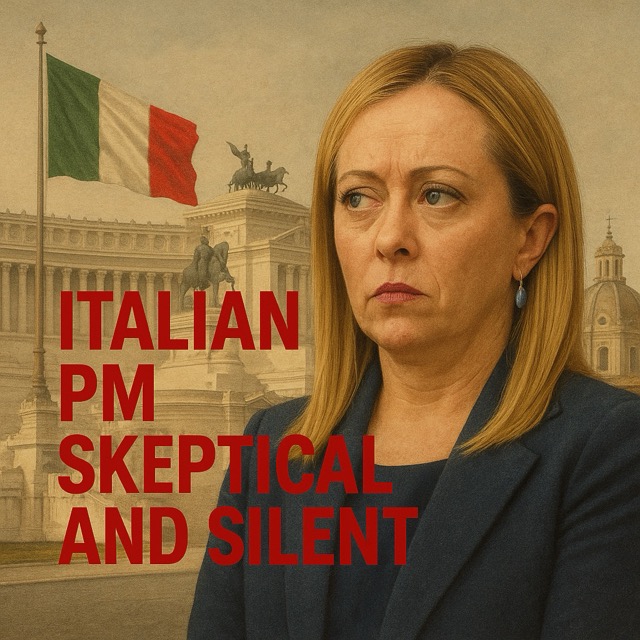
Italy’s Prime Minister Giorgia Meloni has drawn considerable attention for her cautious and, at times, evasive approach to key international crises. Two issues in particular have sparked public and diplomatic concern: her skepticism toward the European coalition of the “willing” on migrant redistribution, and her notable silence on the ongoing humanitarian crisis in Gaza.
Meloni, a prominent figure of Italy’s far-right, has maintained a firm stance against proposed mechanisms to redistribute migrants arriving in southern Europe to other EU member states. While other European leaders have expressed readiness to participate in voluntary relocation schemes, Meloni has voiced doubts over their efficacy and fairness. She insists that border protection and externalization of asylum procedures should take precedence over relocation, a position that resonates with her domestic political base but strains Italy’s relationships within the EU.
Her skepticism toward this coalition of the willing suggests a broader reluctance to engage in shared responsibility, reinforcing perceptions that Italy under her leadership is retreating from multilateral cooperation in favor of nationalist solutions. Critics argue that such a stance risks isolating Italy from important EU policy-making and undermines the spirit of European solidarity.
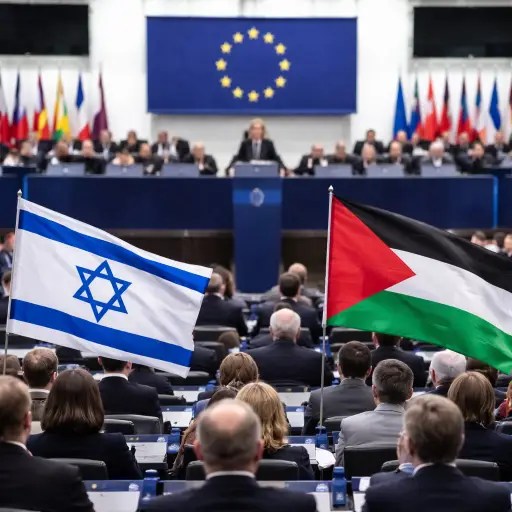
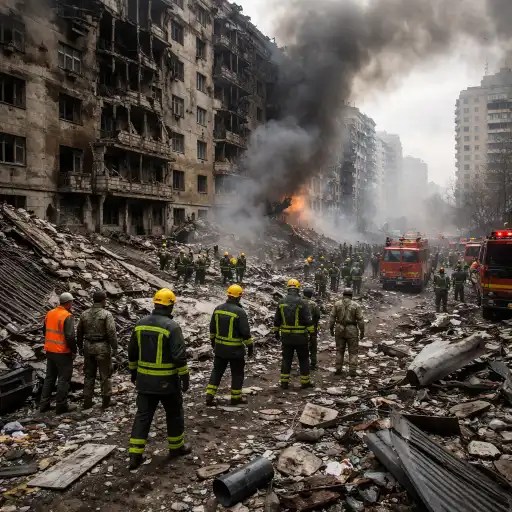
Even more contentious, however, has been Meloni’s near-total silence on the situation in Gaza. As Israeli military actions intensify and civilian casualties mount, several European leaders have publicly called for ceasefires, humanitarian corridors, and accountability for potential violations of international law. Meloni, in contrast, has offered only minimal commentary, often limited to vague affirmations of Israel’s right to self-defense.
This silence has raised eyebrows among international observers and human rights advocates. Italy, historically a strong proponent of diplomatic balance in the Middle East, now appears aligned more squarely with Israeli policy, under Meloni’s leadership. Her government’s reticence to speak out against the suffering in Gaza has been interpreted by many as a political calculation—one that avoids alienating key allies like the United States and Israel while maintaining domestic political support.
Domestically, reactions are mixed. Some segments of the Italian population support Meloni’s positions, seeing them as expressions of strong leadership and national interest. Others, particularly on the left and among civil society groups, decry her lack of moral clarity and international engagement. Protests and open letters have emerged, urging the government to take a more active role in advocating for peace and human rights.
In the broader context, Meloni’s dual approach—assertive on migration, silent on humanitarian crises—signals a reshaping of Italy’s foreign policy. No longer a middle-power broker or vocal humanitarian voice in Europe, Italy may be moving toward a more insular, interest-based diplomacy under her tenure.
As international crises continue to test the resolve and values of European leaders, Italy’s direction under Meloni will remain under close scrutiny. Whether this approach yields long-term strategic benefit or diplomatic isolation remains to be seen.


 The Tower Post