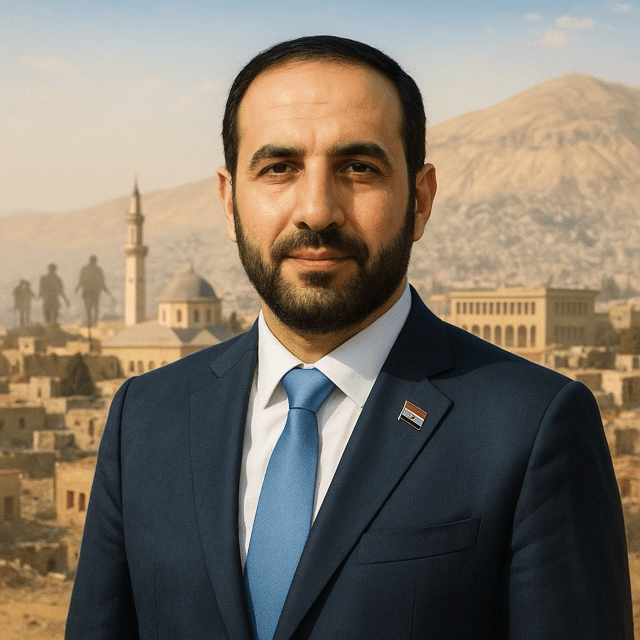
When former rebel commander Abu Mohammad al‑Jolani strode into Damascus last December, television anchors introduced him by his birth name, Ahmed al‑Sharaa, and by a startling new title: transitional president of the Syrian Arab Republic. Just a decade earlier, Washington had listed him as a “specially designated global terrorist.” The distance he has travelled—from jihadist insurgent to head of state—explains why every major capital is asking the same question: How deep does the new leadership’s jihadist DNA still run?
Origins in Iraq’s Insurgency
Al‑Sharaa’s militant career began in 2003, when the 21‑year‑old crossed into Iraq to fight U.S. forces alongside Abu Musab al‑Zarqawi’s al‑Qaeda in Iraq (AQI). Captured in Mosul in 2005, he spent nearly five years in Camp Bucca, the same prison that incubated many future Islamic State commanders. After his release he returned to Syria, forming Jabhat al‑Nusra in 2012 as the official Syrian franchise of al‑Qaeda. U.S. officials blamed the group for some of the war’s most lethal car‑bombings, including the February 2013 attack on Aleppo’s Justice Palace that killed more than 70 civilians.
Rebranding and the Birth of HTS
Facing international isolation and inter‑rebel infighting, al‑Sharaa announced in July 2016 that Jabhat al‑Nusra was severing ties with al‑Qaeda and rebranding as Jabhat Fateh al‑Sham. Six months later it merged into Hay’at Tahrir al‑Sham (HTS), a coalition that presented itself as a “Syrian national revolutionary movement.” Al‑Qaeda’s central command promptly disowned the move as a breach of religious oath, while many hard‑line foreign fighters defected to Islamic State remnants. Western analysts remained skeptical, noting that HTS retained Nusra’s commanders, religious police, and taxation apparatus.
Political Pivot and the “Damascus Dash”
HTS’s decision to tolerate U.N. aid convoys and court local civil councils laid the groundwork for an unexpected military breakthrough in late 2024. As Assad’s army collapsed under simultaneous offensives in Aleppo, Hama, and Homs, HTS spearheaded the rebel “Damascus Dash,” entering the capital almost unopposed. By the time regime loyalists fled to the coast, al‑Sharaa had convened a provisional cabinet drawn largely from the Syrian Salvation Government, the administrative arm HTS had nurtured in Idlib since 2017.
International Reception: Pragmatism vs. Precedent
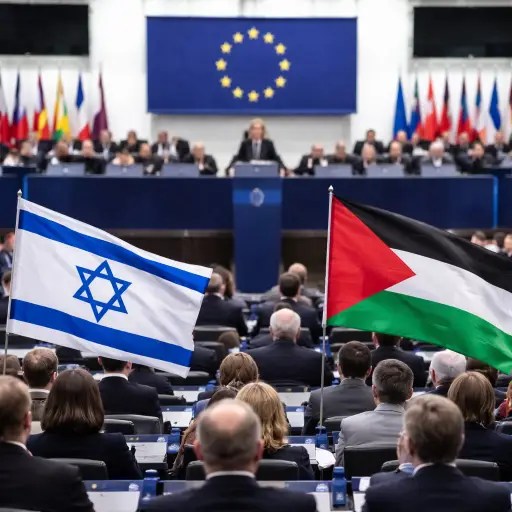
The United States, European Union, and Gulf monarchies now face a policy dilemma. Washington still lists HTS as a terrorist entity, yet in May 2025 former U.S. President Donald Trump met al‑Sharaa in Riyadh and signaled readiness to lift bilateral sanctions “to give Syrians a fresh start.” Israeli officials, by contrast, warn that legitimizing a leader with al‑Qaeda lineage sets a dangerous precedent for Islamist militancy in the region.
Has the Ideology Really Changed?
Supporters argue that al‑Sharaa’s jihadism was always context‑driven. They point to HTS’s 2023 ban on attacking Western targets and its protective patrols for Christian villages in Idlib as evidence of ideological moderation. Critics counter that core doctrine remains Salafi‑jihadi: HTS courts still apply a strict interpretation of Sharia, and senior cleric Abdullah al‑Muhaysini—once an al‑Qaeda fundraiser—continues to wield influence behind the scenes. A recent Washington Institute briefing cautions that “any broader delisting of HTS…needs to be earned, not gifted.”
Governance Tests Ahead
Inside Syria, the transitional government’s immediate challenge is to integrate disparate rebel factions—many with harder‑line agendas than HTS—into a single security architecture. International donors are tying reconstruction funds to visible steps such as dissolving HTS’s amniyat (internal security), releasing secular activists from detention, and allowing U.N. monitors into former Nusra strongholds. So far, progress has been halting. U.N. envoy Geir Pedersen told reporters that HTS has sent “good messages of unity,” but stressed that sustained behavioral change, not rhetoric, will determine future recognition.
Conclusion: From Bayat to Ballots?
Whether Syria’s new leadership can complete its metamorphosis from jihadist vanguard to pluralistic government will hinge on deeds more than declarations. Ahmed al‑Sharaa’s journey illustrates the fluid boundaries between ideology, insurgency, and statecraft in a decade‑long civil war. If former al‑Qaeda operatives can now command parades in Damascus rather than detonating bombs beneath it, the international system must decide whether to engage, contain, or undermine them—aware that the answer may set the template for other conflicts where extremists reinvent themselves as politicians.


 The Tower Post