The Korean Demilitarized Zone has rarely felt as brittle as it does this spring. On 8 May 2025 Pyongyang launched a salvo of short‑range ballistic missiles that flew up to 800 km, a test South Korean analysts believe was designed to prove the reliability of missiles North Korea now exports to Russia. The launch came barely twenty‑four hours after Kim Jong Un toured a munitions plant and ordered shell production “at high speed,” a drive that Seoul’s intelligence service says is already feeding Moscow’s war in Ukraine with millions of rounds.
Flashpoints along the frontier
Missiles are only one facet of the pressure campaign. On 8 April about ten armed North Korean soldiers briefly crossed the Military Demarcation Line inside the DMZ, prompting South Korean troops to fire warning shots and broadcast loudspeaker alerts before the intruders retreated. Meanwhile, Pyongyang’s now‑routine “trash balloons” continue to drop refuse and propaganda over southern farmland, underscoring how the North uses low‑cost harassment to keep the South on edge. Military planners in Seoul warn that the 2018 inter‑Korean tension‑reduction accord is “functionally dead,” as both sides resume front‑line live‑fire drills and electronic jamming.
A distracted capital
Ordinarily such provocations would dominate headlines in Seoul. Instead, domestic politics has consumed the nation since President Yoon Suk‑yeol was impeached on 4 April for declaring martial law during last winter’s street protests. The Constitutional Court’s unanimous verdict has forced a snap presidential election set for 3 June 2025. The campaign is unfolding amid partisan brawls, a hung National Assembly and a public focus on record youth unemployment and soaring living costs.
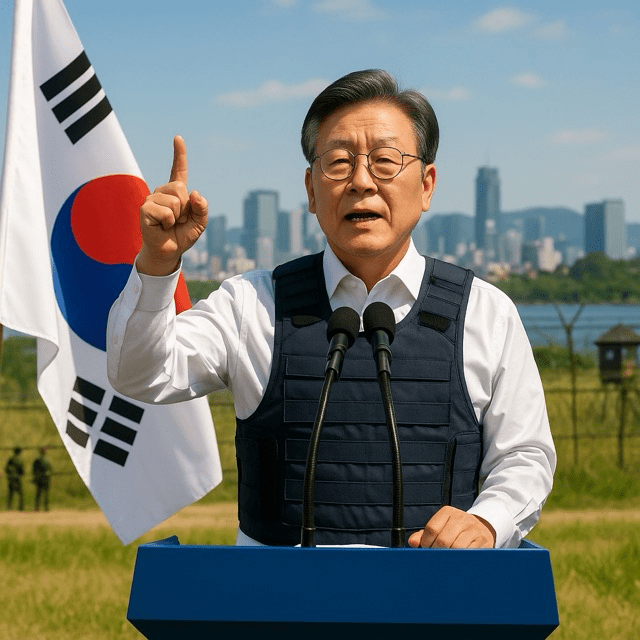
The front‑runner, liberal opposition leader Lee Jae‑myung, now appears at rallies wearing a bullet‑proof vest after police confirmed credible assassination threats allegedly linked to hard‑line supporters of the ousted president. Conservative factions are equally divided; their candidate, former labour minister Kim Moon‑soo, was briefly replaced in an internal coup before clawing back the nomination. The result is a political class fixated on survival while security bureaucrats warn that North Korea is “probing for weakness.”
Strategic implications
South Korean diplomats concede that the leadership vacuum limits Seoul’s ability to coordinate with Washington and Tokyo just as Pyongyang deepens its military partnership with Moscow. U.S. Forces Korea officials testified to Congress last month that Russian technicians are likely transferring satellite and missile guidance technologies to the North—advances that could shorten warning times for any strike on the South.
What happens next?
Analysts outline three plausible scenarios for the coming weeks:
Escalatory cycle — Intelligence officials fear that North Korea may stage a limited artillery barrage across the Northern Limit Line or another DMZ incursion during South Korea’s election week, betting that a caretaker administration will struggle to calibrate its response.
Policy whiplash — Lee Jae‑myung pledges to restart inter‑Korean dialogue and humanitarian aid, while Kim Moon‑soo vows tougher sanctions and a return of loudspeaker propaganda. Either course reversal risks miscalculation if enacted abruptly.
Alliance stress test — Washington has pressed all candidates to affirm that extended deterrence—and the recently formed Nuclear Consultative Group—will survive the political transition. Any hint of wavering could embolden Pyongyang or provoke additional Russian technology transfers.
Conclusion
A decade of rolling crises has taught Koreans to manage confrontation with the North, but seldom have external threats converged with so much internal volatility. As one retired ROK general put it this week, “The enemy is watching our primaries as closely as our polling stations.” Whether Seoul can navigate the weeks ahead without handing Kim Jong Un another opening will depend less on missile defenses than on the resilience of South Korea’s battered political institutions.



 The Tower Post