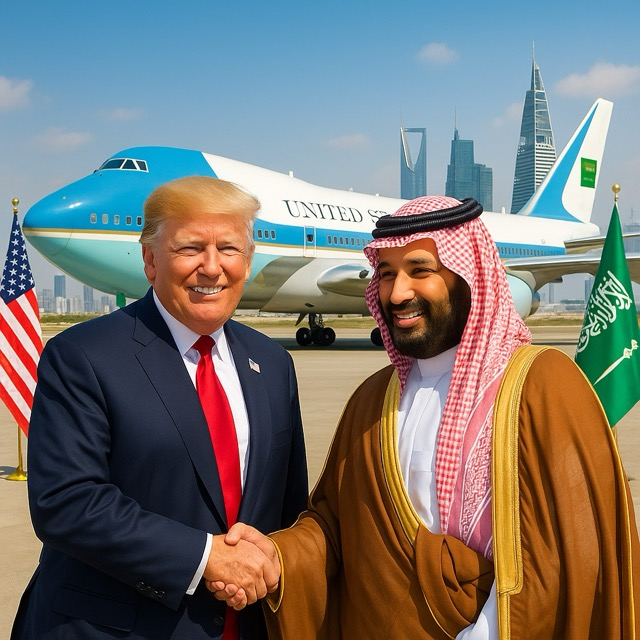
When former President Donald Trump touched down in Riyadh on 13 May 2025, Saudi F‑15s escorted Air Force One in a showy salute that set the tone for a visit heavy on pageantry—and on billion‑dollar business. Speaking at the U.S.–Saudi Investment Forum alongside Crown Prince Mohammed bin Salman, Trump called the bilateral bond “a bedrock of security and prosperity … closer, stronger and more powerful than ever before.”
Deals that dwarf past accords
During a single morning’s ceremony the two governments unveiled a US $600 billion package that bundles a US $142 billion defense tranche with vast artificial‑intelligence and energy ventures. A separate Politico dispatch noted that U.S. tech and finance chiefs—from Elon Musk to BlackRock’s Larry Fink—stood at Trump’s side, underscoring how deeply Wall Street and Silicon Valley now court Gulf capital.
A strategic romance
Strategists see the courtship as transactional: Riyadh gains advanced weapons and semiconductor know‑how, while Washington secures petrodollars for domestic infrastructure and an Arab partner against Iranian resurgence. Yet the spectacle also rehabilitates Mohammed bin Salman on the world stage, five years after U.S. intelligence pinned Jamal Khashoggi’s murder on him. Trump’s repeated praise—he called the crown prince “a visionary moderniser”—has angered human‑rights groups but delighted investors, who view Saudi megaprojects such as NEOM as open spigots for foreign capital.
The jet that launched an ethics storm
Goodwill abruptly collided with constitutional headaches when reports surfaced that Trump was considering a foreign‑funded replacement for Air Force One. The concrete offer, confirmed by multiple outlets, actually comes from Qatar: a luxury Boeing 747‑8 worth about US $400 million, touted as a stop‑gap until Boeing finishes its delayed VC‑25B fleet. Trump brushed aside criticism: “Only a fool would turn down a free, very expensive airplane,” he told reporters.
But the episode reignited an older rumor in Riyadh business circles that Saudi Arabia, not Qatar, first floated the idea of underwriting a presidential jet during back‑channel talks in late 2024. Ethics lawyers stressed that accepting any such gift from any foreign government without congressional approval would almost certainly violate the Constitution’s Foreign Emoluments Clause and undermine civilian control of the military.
‘Folly’ in three dimensions
1. **Security** – Converting a foreign aircraft to presidential specifications would require stripping and rebuilding its communications core, raising supply‑chain and espionage risks.
2. **Legal/ethical** – Gifts of “extraordinary value” from foreign powers are forbidden unless expressly accepted by Congress; the proposed jet is worth roughly 2,000 times the statutory limit.
3. **Political optics** – For a president who campaigned on “America First,” critics say banking a Gulf royalty’s largesse looks less like hard‑nosed deal‑making and more like feudal patronage.
Saudi silence and Washington angst
Riyadh has neither confirmed nor denied any offer, but Saudi officials privately say the kingdom has no current plan to provide an aircraft to the U.S. government. Still, Democratic lawmakers on the House Oversight Committee have asked the State and Defense Departments for all communications regarding any prospective aircraft gift from Saudi Arabia or other Gulf states, arguing that even exploratory talks could compromise U.S. foreign‑policy independence.
The road ahead
For now, the White House insists the Qatari 747 would pass to the Department of Defense, not Trump personally, but legal scholars counter that the Constitution makes no such distinction. Whether the aircraft ever carries the call‑sign Air Force One may depend on Congress—and on public appetite for what one senator dubbed “the most expensive souvenir in diplomatic history.”
None of that dims the jubilation in Riyadh. Saudi ministers point to the week’s megadeals as proof that, controversies aside, the partnership endures. Yet the jet saga underscores a broader lesson: in diplomacy, gifts can be more politically explosive than missiles, and even the warmest bilateral embrace can be singed by the fine print of American ethics law.
 The Tower Post