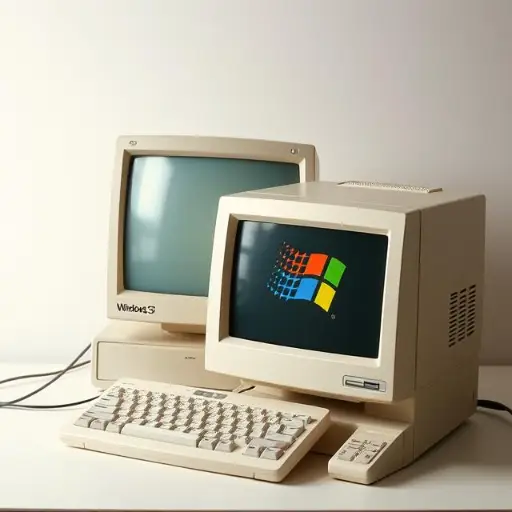
A Quarter Century of Outdated Software and Ancient Machines

As technology marches on, some people get trapped using decades-old software and devices. A glimpse into the history of computing can be seen in the most unexpected places, from hospital elevators to ATMs and even high-speed trains. This phenomenon is a testament to Microsoft’s enduring legacy, which has left an indelible mark on our digital world.
In a hospital elevator in New York City, a screen built into the side of the lift displayed an error message from an operating system released almost a quarter of a century ago – Windows XP. This year marks the 50th anniversary of Microsoft, and the company has been the first or second most valuable business on earth for the better part of five years. Despite its decline in cultural cachet, Microsoft is betting on AI to carry it into the next generation of computing.
But as it dumps tens of billions of dollars into bleeding-edge technology, some argue that one of Microsoft’s most enduring legacies may be the marks it left on society long ago. Since its launch in 1975, Microsoft has penetrated digital infrastructure so completely that much of our world still relies on aged, sometimes obsolete Windows software and computers, chugging along and gathering dust long after they first booted up.
For people stuck using these machines, the ghosts of Windows’ past are an ever-present feature of daily life. Lee Vinsel, an associate professor at Virginia Tech, says that Windows is the ultimate infrastructure, and its systems are built into everything around us. “Their systems are built into everything around us, and the fact that we have all of these ancient examples around is the story of the company’s overall success,” Vinsel says.
Even if you’re a diehard Apple user, you’re probably interacting with Windows systems on a regular basis. When you’re pulling cash out, for example, chances are you’re using a computer that’s downright geriatric by technology standards. Many ATMs still operate on legacy Windows systems, including Windows XP and even Windows NT, which launched in 1993.
According to Elvis Montiero, an ATM field technician, the challenge with upgrading these machines lies in the high costs associated with hardware compatibility, regulatory compliance, and the need to rewrite proprietary ATM software. Microsoft ended official support for Windows XP in 2014, but Montiero says many ATMs still rely on these primordial systems thanks to their reliability, stability, and integration with banking infrastructure.
There are plenty of other surprising applications of old Microsoft products hidden in everyday life. In 2024, Windows was at the center of a controversy across the German internet. A job listing for Deutsche Bahn, the country’s railway service, required applicants to have expertise with Windows 3.11 and MS-DOS – systems released 32 and 44 years ago, respectively.
In certain parts of Germany, commuting depends on operating systems that are older than many passengers. A Deutsche Bahn spokesperson says that’s to be expected, as the trains have a long service life and are in operation for up to 30 years or longer. The trains in San Francisco’s Muni Metro light railway also rely on old technology, with someone having to stick a floppy disk into the computer that loads DOS software on the railway’s Automatic Train Control System (ATCS).
In a brightly lit room in San Diego, California, two of the biggest printers you’ve ever seen are hooked up to servers running Windows 2000, an operating system named for the year it was released. John Watts, who handles high-end printing and post-processing for fine art photographers, says the result is an image of unparalleled quality. Long out of production, the few remaining LightJets rely on the Windows operating systems that were around when these printers were sold.
For the people who use this old technology, life can get tedious. Psychiatrist Eric Zabriskie would show up to his job at the US Department of Veterans Affairs (VA) and start the day waiting for a computer to boot up. “I had to get to the clinic early because sometimes it would take 15 minutes just to log into the computer,” Zabriskie says. “Once you’re in you try to never log out. I’d hold on for dear life. It was excruciatingly slow.”
The main culprit behind decrepit computer systems is generally “deferred maintenance,” says M Scott Ford, a software developer who specialises in updating legacy systems. “Organisations put all their attention on adding new features instead of investing those resources into making improvements on [the basics of] what already exists,” Ford says, which allows reliance on older technology to build up over time.
In some cases, however, old computers are a labour of love. Dene Grigar, director of the Electronic Literature Lab at Washington State University, Vancouver, spends her days in a room full of vintage and fully functional computers dating back to 1977. “As soon as people got their hands on computers they started making art,” Grigar says, and she’s dedicated to preserving it.
Microsoft’s approach of letting organisations leverage the hardware they already have and chasing them for software licenses has given the company a huge advantage in securing business clients. It’s part of why these old Windows machines hang around for so long, Ford says. “Microsoft is just something you get stuck with.”