Huang warns that restrictions may backfire, accelerating China’s domestic tech capabilities
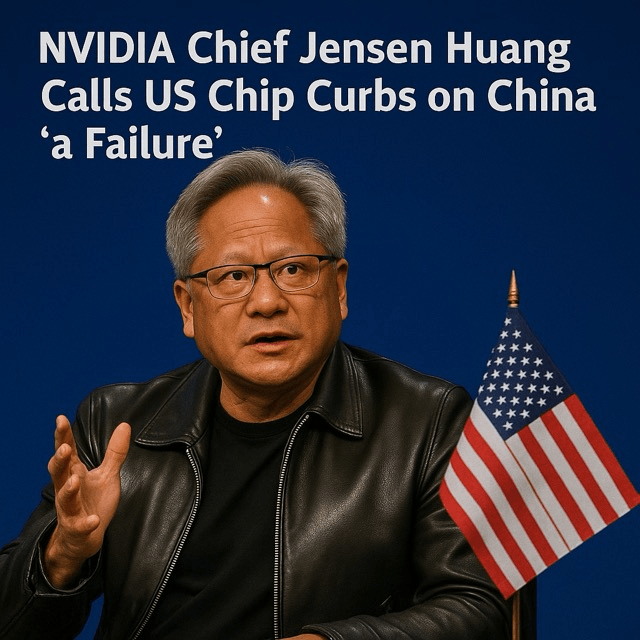
In a candid assessment of current U.S. export policy, Nvidia CEO Jensen Huang has labeled the Biden administration’s semiconductor restrictions on China as ‘a failure,’ arguing that the strategy is undermining U.S. technological leadership and inadvertently accelerating China’s self-sufficiency in chip design and production.
Speaking at the Computex tech conference in Taipei on May 20, 2025, Huang expressed deep concern over Washington’s continued imposition of export controls targeting advanced graphics processing units (GPUs) and artificial intelligence (AI) chips. The controls, which began in 2022 and have intensified in recent months, were intended to curb China’s access to high-performance computing hardware used in military, surveillance, and AI applications.
‘We’ve entered a new era of competition, not just in technology but in innovation systems,’ Huang told an audience of industry leaders. ‘But if your strategy is simply to stop your competitor from playing, rather than out-innovate them, you will lose.’
Huang emphasized that while the initial restrictions hurt Chinese companies in the short term, they also gave Beijing a powerful incentive to invest in domestic alternatives. ‘China has rallied behind its national chip ambitions like never before,’ he said. ‘Now they are not just catching up—they are beginning to chart their own course.’
According to market analysts, Chinese tech firms have made notable strides in developing homegrown chips with comparable AI capabilities, leveraging investments from state funds and collaborations with academic institutions. While lagging in certain fabrication technologies, Chinese players are narrowing the gap in AI inference chips and cloud computing infrastructure.
Huang’s comments come as Nvidia itself grapples with the fallout from these curbs. The company has had to redesign several of its flagship chips to comply with U.S. export rules, delaying product timelines and altering supply chains. Although Nvidia continues to lead the global AI hardware market, its revenue from China—a key growth driver—has sharply declined.
The U.S. government has defended the curbs as a necessary national security measure. In a statement responding to Huang’s remarks, a spokesperson for the Commerce Department said, “We stand by our policy. These restrictions are narrowly targeted and ensure that our most advanced technologies do not support authoritarian military applications.”
However, some tech policy experts share Huang’s concerns. ‘The current approach risks bifurcating the global tech ecosystem,’ said Emily Chen, a fellow at the Brookings Institution. ‘In trying to contain China’s growth, we may be catalyzing a technological Cold War that undermines global innovation and supply chain resilience.’
Despite the tensions, Huang reiterated his belief in open competition and collaboration. He called for renewed dialogue between the U.S. and China on tech ethics, standards, and mutual interests. ‘Technology should unite us, not divide us,’ he said. ‘The future of AI must be built on cooperation and shared values.’
As one of Silicon Valley’s most influential voices, Huang’s critique adds pressure on policymakers to reassess the balance between national security and global innovation. With the semiconductor industry at the heart of economic and strategic power in the 21st century, the stakes have never been higher.
The Nvidia chief concluded his speech with a warning and a challenge: ‘You can’t lead the future by banning others—you lead by running faster. Let’s not slow down innovation by putting up walls.’




 The Tower Post