CNTE blockade forces President Sheinbaum’s morning briefing online and intensifies the pension‑reform standoff
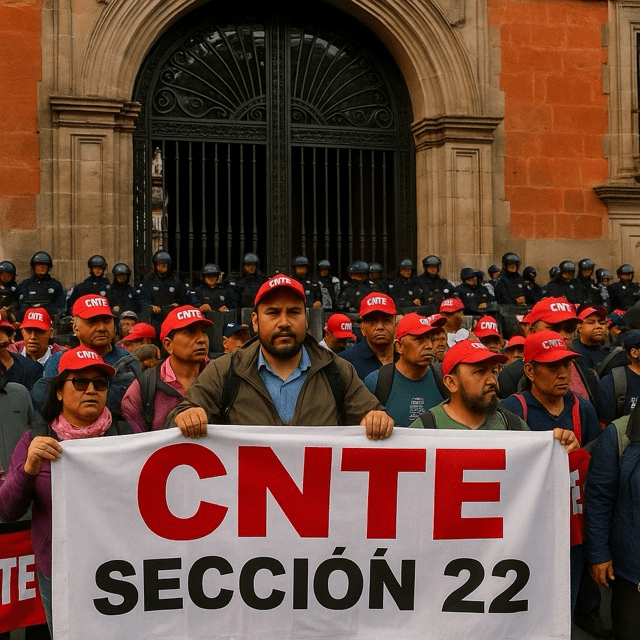
Mexico City — Dawn had barely broken on 21 May 2025 when hundreds of striking teachers hauled aside the steel barricades ringing Mexico’s National Palace and formed a human cordon across its monumental doorways. The blockade by the dissident National Coordinator of Education Workers (CNTE) shut journalists, civil servants and even the presidential press team out of the colonial‑era complex, forcing President Claudia Sheinbaum to conduct her daily “mañanera” press conference by video link for the first time in her administration.¹
The dramatic move punctuated the seventh day of an indefinite strike that began on Teachers’ Day, 15 May. Talks with the interior, education and social‑security ministries yielded nothing beyond the promise of a face‑to‑face meeting with Sheinbaum on Friday—a meeting the president has yet to confirm.² While rank‑and‑file teachers chanted “¡Abrogación o nada!” in the Zócalo square, union negotiators said government officials merely recycled proposals already rejected at earlier bargaining tables.
At the heart of the standoff lies the CNTE’s demand to scrap the 2007 ISSSTE pension reform, which replaced a solidarity‑based pay‑as‑you‑go scheme with individual savings accounts. Educators also seek a 100 % wage hike, repeal of what they call a ‘punitive’ teacher‑evaluation system and the reinstatement of colleagues fired under the 2013 education reform. Sheinbaum insists the treasury cannot absorb the estimated US $25 billion cost of reversing the pension law. Instead she has offered a 9 % retroactive pay raise, a further 1 % bump in September and an extra week of annual leave—concessions the CNTE dismisses as “crumbs.”³
Wednesday’s blockade unfolded with theatrical precision. Teachers—many wearing the red bandanas of CNTE Sección 22—dragged metal police fencing aside, lit small bonfires of cardboard placards and unfurled banners accusing the government of ‘looting our retirement.’ National Guard troops remained on the perimeter but did not intervene. Reporters arriving to cover the president were turned away; inside the palace, staff scrambled to set up a Zoom feed from the Tesorería hall as technicians routed questions through an online chat. “We will not fall for any provocation,” Sheinbaum said at the start of the broadcast, reiterating a no‑repression pledge.⁴
The president’s restraint reflects both electoral arithmetic—teachers remain an influential constituency—and memories of lethal crackdowns on protests in past decades. Yet the standoff is also testing Sheinbaum’s message of fiscal prudence. Business chambers warned that continued blockades could cost the historic centre up to 120 million pesos (US $6.5 million) a day in lost commerce. The mainstream National Union of Education Workers (SNTE) urged ‘dialogue without coercion,’ while distancing itself from the more radical CNTE tactics.
Analysts note that the CNTE’s decentralized structure—rooted in Oaxaca, Chiapas and Guerrero—makes discipline difficult: local assemblies could escalate to airport or highway closures if Friday’s meeting fails. Security experts warn that patience within the National Guard is thinning after a week of round‑the‑clock deployment.
The showdown is the latest in the CNTE’s long history of disruptive tactics. In March 2025 the same union capped a 72‑hour strike with a march on the National Palace before pitching a tent city in the Zócalo.⁵ A decade earlier, CNTE protests paralysed Mexico City for weeks amid clashes over the Peña Nieto administration’s education overhaul.
Mexican law protects the right to social protest, but blocking federal buildings can trigger criminal charges under the National Security Act—a threat previous governments have rarely enforced for fear of inflaming tensions. Constitutional lawyers argue that the CNTE’s pension grievance has broader relevance: the ISSSTE law affects some 3.2 million public‑sector workers nationwide.
Public opinion, meanwhile, is split. A Buendía & Márquez poll released Tuesday found 48 % of respondents supported the teachers’ goals but 52 % opposed the blockade. Sheinbaum’s overall approval dipped four points to 58 %, its lowest since she took office last year.
Internationally, the protests have raised eyebrows just as the president prepares to host Latin American leaders for a regional summit next month. Diplomats in Mexico City say they are ‘monitoring the security environment’ around the Zócalo, the capital’s cultural heart and a magnet for tourists.
All eyes now turn to Friday. If the palace gates reopen and dialogue advances, the teachers’ tents may fold back into classrooms. If not, Mexico’s most symbolically charged doorway could remain sealed—transforming the CNTE’s gateway of discontent into a siege with unpredictable political costs.



 The Tower Post