How a little‑known Swiss‑incorporated NGO, backed by the US and Israel, seeks to replace the UN—and why critics call it a ‘fig leaf’ for displacement.
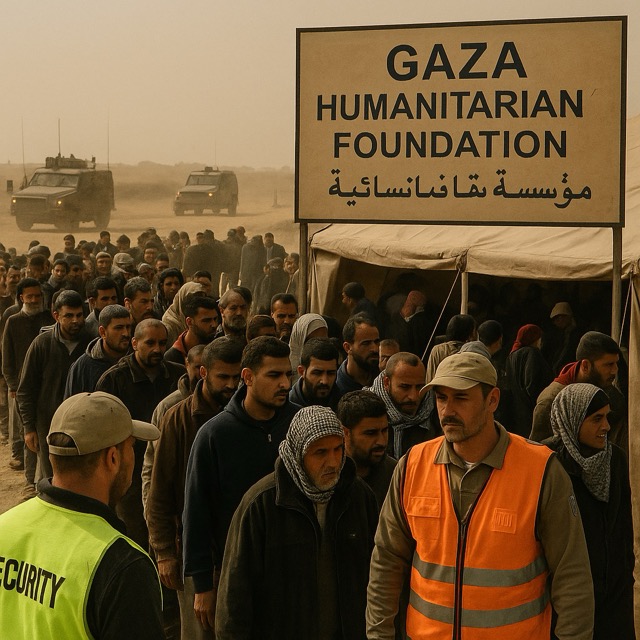
On 14 May 2025 a terse press release announced the birth of the Gaza Humanitarian Foundation (GHF), a Swiss‑incorporated non‑profit that few in the aid world had ever heard of. Backed by Washington and quietly green‑lit by the Israeli security cabinet, the fledgling body promises to “deliver 300 million meals in ninety days” to a besieged population teetering on the edge of famine. Its rollout, observers say, could redraw the entire humanitarian map of Gaza.
The concept behind GHF emerged in late 2024 during closed‑door meetings in Tel Aviv’s Kirya compound between Israeli defence planners and a cadre of retired US intelligence operatives led by CIA veteran Phil Reilly. Internal documents, first reported by the Washington Post, show that the designers saw “humanitarian bubbles” as a way to satisfy Netanyahu’s demand that aid not “sustain Hamas” while relieving mounting international pressure.
Legally, GHF is a maze of shell entities: a Swiss association incorporated in February by an Armenian accountant with no prior relief record, and a still‑unnamed American branch. Its executive director is Jake Wood, the ex‑marine who co‑founded disaster‑response NGO Team Rubicon, while early drafts listed World Food Programme laureate David Beasley and World Central Kitchen’s Nate Mook as board members—both have since publicly disavowed any role.
Instead of the 400 micro‑distribution points currently coordinated by the UN, GHF plans just four heavily guarded hubs—initially all in southern Gaza. Palestinians would be biometrically vetted, receive pre‑packed rations once or twice a month, and then trek home through rubble‑choked roads. Security will be subcontracted to US firms Safe Reach Solutions and UG Solutions, whose private contractors have already arrived in Israel, according to Israeli media.
GHF insists the Israeli Defence Forces will keep a 1,000‑foot buffer and that aid staff will carry no offensive weapons. Yet senior IDF officers told the Post they fear stampedes, unclear rules of engagement and the optics of “armed foreigners policing hungry civilians.”
Humanitarian agencies have reacted with near‑unanimous scepticism. UN aid chief Tom Fletcher branded the scheme “a fig leaf for further displacement,” warning that concentrating aid south of Wadi Gaza could coerce northerners to move yet again. Eleven NGOs signed a joint statement calling the model “weaponised aid” that violates the principles of impartiality and independence.
Money remains an enigma. GHF claims an anonymous $100 million pledge, but three people involved in fundraising told the Irish Times that no government or major foundation has transferred funds. Gulf donors once courted as anchor backers have quietly walked away, wary of being seen as abetting forced displacement.
For the Trump administration, GHF is pitched as a way to “leave Hamas empty‑handed and deliver a win for everyone,” in the words of US ambassador Mike Huckabee. Israeli hard‑liners view it as a bridge to a post‑Hamas Gaza under indirect Israeli control, while moderates hope it postpones talk of a costly re‑occupation. Critics counter that outsourcing humanitarian responsibility to a private actor does not absolve an occupying power of its legal obligations.
International law specialists note that if Israel retains overriding security authority it remains bound by the Fourth Geneva Convention to provide for civilians. “You cannot privatise international humanitarian law,” says Dr Amal Saad of Birzeit University. Whether the International Committee of the Red Cross will operate in GHF hubs is still undecided.
For ordinary Gazans—93 percent of whom face acute food insecurity, according to a UN‑supported assessment—the stakes are starkly practical: Will food actually reach them? Aid logisticians fear that the hub‑and‑spoke design, combined with cratered roads and soaring fuel costs, will leave northern Gaza in a “humanitarian blackout.”
Not all involved remain convinced. A former board adviser told the Post the plan “seems to be morphing by the hour,” while some IDF officers privately argue that the hub concept is “not going to work on a golf course, let alone in Gaza.”
Despite the turbulence, GHF says its first two hubs—in Khan Younis and Rafah—will open before June 1, with two northern sites to follow “subject to security clearance.” Construction crews were still pouring concrete this week.
The UN and the World Food Programme counter that the problem is not logistics but access. “We have thousands of trucks waiting at Kerem Shalom; just let them in,” a WFP official tweeted, echoing calls for a full reopening of crossing points rather than a parallel system.
If GHF succeeds, it could usher in a new paradigm where states outsource large‑scale relief to private, quasi‑military actors—upending seventy‑five years of multilateral humanitarian architecture. If it fails, analysts warn, Israel may tighten the siege even further, arguing that the UN model is untenable and no alternative exists.
For now, the only certainty is uncertainty. Whether the Gaza Humanitarian Foundation becomes a lifeline or a cautionary tale will hinge on its first weeks in the field – under the glare of starving civilians, sceptical humanitarians and a world increasingly impatient for a credible path out of Gaza’s catastrophe.
Sources
Washington Post, “Sweeping overhaul of Gaza aid raises questions of morality and workability”, 24 May 2025.
Irish Times, “The little‑known group poised to take over Gaza’s aid”, 21 May 2025.
Al Jazeera, “What is the Gaza Humanitarian Foundation, and why has it been criticised?”, 20 May 2025.
Wikipedia, “Gaza Humanitarian Foundation”, last modified 22 May 2025, accessed 24 May 2025.



 The Tower Post