A pragmatic turn in London and Brussels ushers in a strategic partnership on trade, security and climate after years of acrimony.
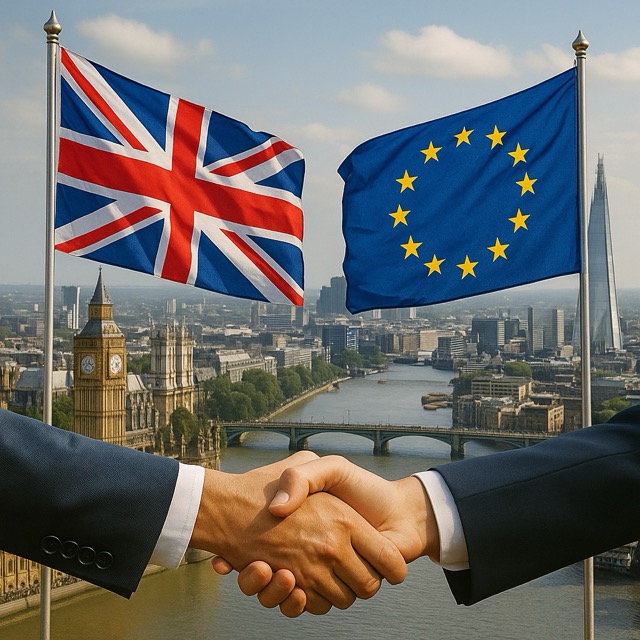
A summit in Brussels on 19 May 2025 marked a turning point in Britain’s long divorce from the European Union.
Over croissants and carbon‑neutral espresso at the Berlaymont, Prime Minister Rachel Reeves and European Commission President Ursula von der Leyen signed what officials called a “Strategic Partnership Roadmap,” sketching out the next five years of cooperation on defence, migration, energy and research.
“Today we stop talking about the past and start building the future,” Reeves declared, flanked by a row of both Union Jacks and EU flags. Von der Leyen added that “geography and geopolitics bind us far more tightly than any treaty ever could.”
From rupture to realism
The mood could hardly have been more different from the bitter 2016–2022 period, when Westminster debates pivoted on sovereignty, fish quotas and the colour of passports. Since the end of the Johnson‑Sunak era, a consensus has emerged in London that managing divergence is costlier than selective alignment. Exports to the EU are 13 % below their 2015 trend, according to the Office for Budget Responsibility, while Foreign Direct Investment from continental firms has halved. Reeves’ Labour government—elected in July 2024 on a pledge to “Make Brexit Work” rather than reverse it—has quietly re‑tuned that slogan to “Move Beyond Brexit.”
The four‑pillar deal
The new roadmap rests on four pillars:
1. Trade smoothing — A streamlined Trusted Agri‑Trader scheme will let British dairy and meat exporters use a single electronic certificate for the whole EU, slashing paperwork by an estimated £450 million a year.
2. Energy coupling — Britain will rejoin the EU’s day‑ahead electricity market coupling, cutting household bills and aiding grid stability as both sides accelerate offshore wind deployment.
3. Youth mobility — A reciprocal visa waiver for under‑30s allows 18‑month work‑and‑travel stays, reviving some of the spirit of the old Erasmus scheme without full programme membership.
4. Security and defence — A formal EU‑UK Security Compact gives Britain observer status in the EU’s Military Mobility project and guarantees access to the PESCO‑funded procurement hub in exchange for a financial contribution tied to GDP.
None of this rewinds Brexit, but taken together the measures chip away at frictions that have hampered everything from touring musicians to perishable food exports.
Northern Ireland: proof‑of‑concept
Officials say that the Windsor Framework—finalised in early 2023 to manage Northern Ireland’s dual‑market status—acted as “a laboratory of pragmatism.” Data from HM Revenue & Customs show a 26 % rise in cross‑border trade on the island of Ireland in 2024, easing fears that the Protocol would isolate Northern firms. The May 2025 roadmap extends Windsor’s digital customs platform to all animal products entering Great Britain, a tacit admission that technology can defuse the sovereignty‑purist objections once levelled at “computerised borders.”
Shared threats drive cooperation
Russia’s protracted war on Ukraine, Houthi attacks in the Red Sea and a fracturing global trading order have forced London and Brussels to close ranks. “If we cannot coordinate on ammunition procurement now, when will we ever?” asked an EU diplomat. The new compact allows British firms back into the EU Satellite Surveillance Fusion Hub—vital for Black Sea grain‑corridor monitoring—while EU navies will join the UK‑led Operation Poseidon to protect undersea cables in the North Atlantic.
Business welcomes—but wants more
The Confederation of British Industry estimates the trade measures could lift UK GDP by 0.35 % by 2030—modest, but politically significant after a decade of stagnation. Automakers still seek a relaxation of the rules‑of‑origin thresholds scheduled for 2027, and City lobbyists are pushing for an Equivalence 2.0 deal on financial services. EU officials warn that cherry‑picking in sensitive areas like chemicals regulation will remain off limits, but hint that a bespoke veterinary accord could be on the table if Britain aligns dynamically with EU food‑safety law.
Public opinion has shifted
Polling by YouGov in April 2025 found that 61 % of Britons now favour a “closer economic partnership” with the EU, up from 45 % in 2021. Yet only 23 % want to re‑enter the bloc. Europe, meanwhile, is less consumed by Brexit fatigue; with war on its eastern flank and the United States drifting toward election‑year uncertainty, the UK is increasingly viewed as a crucial, if awkward, ally.
The politics of forgetting
Conservative leader Tom Tugendhat accuses the government of “Brexit back‑sliding,” while the Reform UK party lambasts a “betrayal of 17.4 million votes.” But the headlines no longer dominate the front pages, displaced by stories on AI regulation, housing shortages and English cricket. In Brussels, Brexit has moved from existential drama to technical annex in summit paperwork.
Beyond Brexit—but not back in
For businesses shipping goods across the Channel and students eyeing Paris or Prague, the difference is concrete. Britain remains outside the customs union and single market; customs declarations persist, and voting rights in EU institutions are absent. But the foundations of a less fractious relationship are being laid—brick by brick, committee by committee. “History rarely offers clean breaks,” notes Professor Anand Menon of UK in a Changing Europe. “What we are seeing is not a reversal but a recognition of interdependence.”
If the roadmap survives the next election cycles on both sides of the Channel, Britain and Europe may finally find themselves looking outward together—rather than inward at the scars of a referendum fought almost a decade ago.
Sources
EU–UK joint statement, Brussels summit, 19 May 2025.
Financial Times, “Britain and Europe are moving beyond Brexit. Now for the real trade‑offs,” 24 May 2025.
Reuters, “UK strikes EU trade and defence reset in ‘new era’ for relations,” 18 May 2025.
The Guardian, “From fishing to Erasmus: what the UK’s deal with the EU will mean,” 19 May 2025.
Carnegie Europe, “The Moment of Truth for a UK‑EU Reset,” 18 May 2025.



 The Tower Post