Emotional Intelligence for Machines: The Vision of 19-Year-Old Entrepreneur Teddy Warner
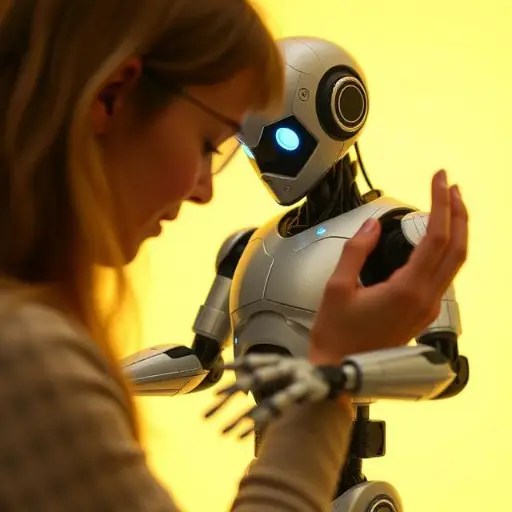
Teddy Warner, a 19-year-old robotics enthusiast, has always been fascinated by the possibilities of creating machines that can interact with humans in a more natural and intuitive way. Growing up in a family with a background in the industry, Warner “grew up” working in a machinist shop while in high school. This hands-on experience not only sparked his interest in robotics but also instilled in him a deep understanding of the importance of human-robot interaction.
Now, Warner is the founder of Intempus, a company that aims to give robots human-like emotional expressions to help humans better understand and predict their movements. According to Warner, current robots lack a crucial aspect of human behavior: physiological state. Unlike humans, who experience emotions such as joy, stress, and excitement, robots are limited to a straightforward “A to C” approach, where observation leads directly to action. This lack of emotional intelligence makes it difficult for humans to communicate with robots in a natural and intuitive way.
Warner believes that by giving robots a “B step” – a physiological state – humans can communicate with them in a more natural and less uncanny way. This, in turn, can lead to more effective collaboration between humans and robots, particularly in industries such as healthcare, transportation, and manufacturing.
Warner’s idea was sparked while working at AI research lab Midjourney, where he realized that the data used to train AI models was often based on robots that lacked spatial reasoning. This led him to experiment with various methods to capture human-like emotional data, including fMRI scans and polygraph tests. However, he found that these methods were not only expensive but also ineffective in capturing the nuances of human emotions.
After some trial and error, Warner found success using sweat data, which he believes can be used to train robots to have emotional compositions. By analyzing sweat patterns, Warner’s team can identify subtle changes in a person’s emotional state, such as increased heart rate or skin conductance. This data can then be used to train robots to mimic human-like emotional expressions, such as smiling or frowning.
Since launching Intempus in September 2024, Warner has spent the first four months researching and developing his technology. He has since expanded his focus to include other areas, such as body temperature, heart rate, and photoplethysmography. These additional modalities will enable Intempus to capture a more comprehensive range of human emotions, making its robots even more human-like.
With a team of seven enterprise robotics partners on board, Warner is now looking to hire and test his technology with humans. His goal is to create robots that can not only mimic human-like emotional expressions but also understand and respond to human emotions in a more intuitive way.
While Intempus is currently focused on retrofitting existing robots, Warner leaves the door open for the possibility of building his own emotionally intelligent robots in the future. “I want to have someone come in and just understand that this robot is a joyful robot, and if I can innately convey some emotion, some intents that the robot holds, then I’ve done my job properly,” he said.
Warner’s vision for Intempus is to create robots that can communicate with humans in a more natural and intuitive way, revolutionizing the way we interact with machines. With his company’s technology on the cusp of a major breakthrough, Warner is confident that he can prove the success of his idea within the next four to six months.
As the robotics industry continues to evolve, Warner’s work at Intempus has the potential to transform the way we interact with machines. By giving robots a human touch, Warner is paving the way for a future where humans and robots can collaborate more effectively, leading to breakthroughs in fields such as healthcare, transportation, and manufacturing.



 The Tower Post