A snapshot of Franco‑Italian cooperation and conflict amid migration rows, Ukraine tensions and transalpine megaprojects.
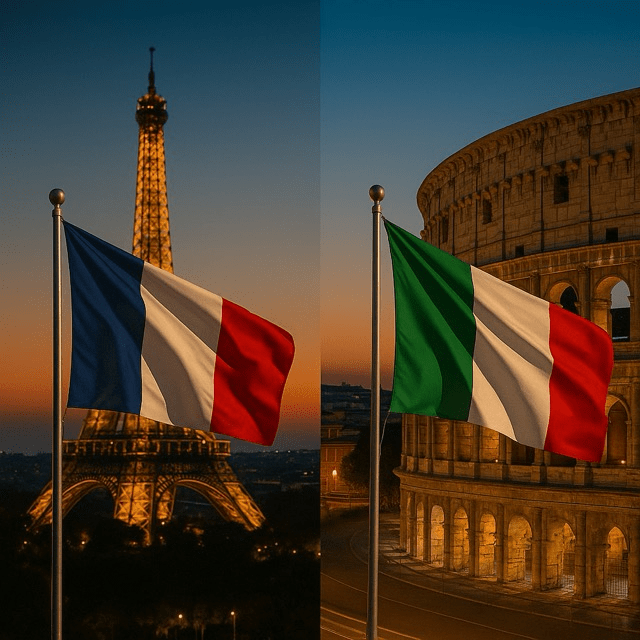
Paris and Rome are the closest of neighbours yet the prickliest of partners. Since the signing of the Quirinal Treaty in 2021, France and Italy have pledged to consult each other “on all major international issues” and to meet annually at cabinet level. Four years on, that pact is still the institutional backbone of the relationship. Yet 2024‑25 has also seen a series of public squabbles—most recently over Ukraine and migration—that remind observers just how fast goodwill can evaporate along the Riviera.
Institutional ballast: the Quirinal framework
The Quirinal Treaty entered into force in early 2022 and created ten thematic working groups spanning defence, space, industry and youth exchanges. Its preamble frames the accord as a way to “advance European integration through Franco‑Italian convergence.” Signatories hoped the mechanism would become to Paris and Rome what the Élysée Treaty is to Paris and Berlin. On 24 November 2024 the two foreign ministers, Jean‑Noël Barrot and Antonio Tajani, met in Rome to celebrate the treaty’s third anniversary and hailed “excellent momentum” before Italy’s G7 presidency.
High‑points: defence, energy and infrastructure
Despite political noise, cooperation has deepened in hard‑security domains. French and Italian submarines trained side‑by‑side during NATO’s Dynamic Manta 25 exercise off Sicily in March 2025, a drill praised by Rear Adm. Bret Grabbe for “maintaining the edge” in anti‑submarine warfare. On land the €25‑billion Lyon–Turin high‑speed rail tunnel reached 35 km of excavation in 2024 and saw the first Franco‑Italian tunnel‑boring machine break ground under the Alps in April 2025—an emblem of shared economic interests and EU‑funded connectivity.
Enduring fault‑line #1: migration
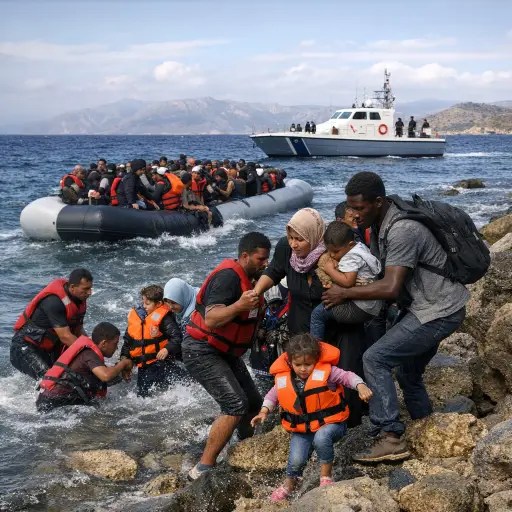
If defence unites, migration still divides. A May 2023 outburst by France’s interior minister Gérald Darmanin—who called Giorgia Meloni “unable to solve migration problems”—prompted Italy’s foreign minister to cancel a visit to Paris and triggered days of mutual recrimination. Although the two sides have since converged on tougher external‑border controls and joint returns, cross‑border tensions at Ventimiglia and Menton flare whenever asylum flows surge, and public opinion in both countries remains highly sensitive.
Enduring fault‑line #2: Ukraine diplomacy
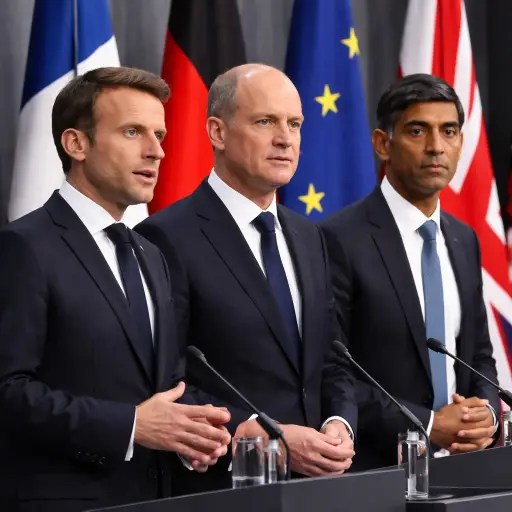
The most recent quarrel arrived in May 2025 after Italian media revealed that Meloni had been left out of a small group of European leaders who spoke with U.S. President Donald Trump and Volodymyr Zelenskyy. Macron accused her of spreading “false information,” while German chancellor Friedrich Merz rushed in to patch things up.citeturn2view0 The spat underscored differing instincts: Paris, keen on strategic autonomy, vs. Rome’s Atlanticist caution about sending troops—or about being seen to send them.
Areas of pragmatic alignment
Away from the headlines, civil‑servant‑level work proceeds apace. Under Italy’s 2024‑25 G7 presidency, Paris and Rome co‑drafted the Venaria Communiqué on sustainable energy; their finance ministries jointly advocate an EU “competitiveness shock” and looser fiscal rules for green investment. Joint programmes now link CNES and the Italian Space Agency on satellite launchers, and Leonardo and Thales continue to integrate air‑defence radars.
Outlook
Franco‑Italian relations thus resemble a high‑performance sports car: engineered for speed but prone to skidding on sharp curves. The Quirinal Treaty keeps the wheels aligned, but politics— from migration to Ukraine—regularly throws grit into the gearbox. If Meloni and Macron can resist the temptation of domestic point‑scoring, 2025 could yet see the partnership mature into a stabilising pillar alongside the venerable Franco‑German axis. Failing that, Europe may have to get used to periodic black‑ice patches on the road linking the Seine and the Tiber.
 The Tower Post