From endowment taxes to affirmative‑action probes, how America’s 45th—and 47th—president turned an Ivy League symbol into a political foil.
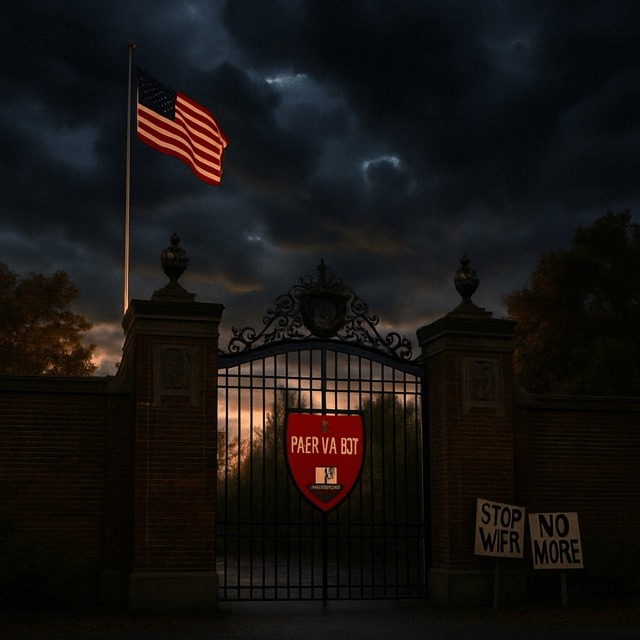
When Donald J. Trump first campaigned for the White House in 2016, he cast the nation’s most prestigious universities as bastions of liberal elitism that looked down on “forgotten Americans.” Harvard University—wealthy, influential, and synonymous with the Democratic establishment—quickly became a convenient villain. Nearly a decade later, with Trump back in the Oval Office after his 2024 comeback victory, that antagonism has hardened into a multi‑front conflict that encompasses tax policy, immigration rules, and allegations of civil‑rights fraud.
The opening salvo: taxing the endowment
The first shot was fired not from the West Wing but from Capitol Hill. The Tax Cuts and Jobs Act of December 2017 included a little‑noticed provision imposing a 1.4 percent levy on the net investment income of private colleges with endowments exceeding \$500,000 per student. Harvard—whose \$50 billion fund is the largest in higher education—became the public face of the so‑called “Ivies Tax.” Trump sold the measure at rallies as a corrective to “bloated university coffers that don’t pay their fair share.” Critics countered that endowment earnings are poured into student aid and basic research that drives the U.S. innovation economy. Either way, the message was unmistakable: Harvard’s wealth was now fair game.
Admissions on trial
If money was step one, race was step two. In 2014 the conservative group Students for Fair Admissions (SFFA) sued Harvard, claiming its race‑conscious admissions process discriminated against Asian‑American applicants. While the lawsuit pre‑dated Trump, his Department of Justice intervened in 2018 on SFFA’s side and launched its own civil‑rights probe. The DOJ’s amicus brief accused Harvard of “unlawful, intentional discrimination.” Although the university won in federal district and appellate courts, the case rose to the Supreme Court—and with a 6‑3 conservative majority, it became a vehicle for ending affirmative action nationwide. On 29 June 2023, the Court ruled 6‑2 against Harvard and the University of North Carolina, declaring that the educational benefits of diversity could no longer justify explicit consideration of race. Trump hailed the decision as “a powerful rebuke to woke racism.”
Visa wars during the pandemic
In July 2020, as the COVID‑19 pandemic forced campuses online, Immigration and Customs Enforcement announced that foreign students whose courses were fully remote would have to transfer or leave the country. Harvard and MIT sued within 48 hours, arguing that the rule violated the Administrative Procedure Act and endangered the academic standing of 5,000 international scholars. Facing a backlash from business leaders and 17 state attorneys general, the administration rescinded the policy one week later. Yet the incident crystallised Trump’s willingness to weaponise immigration bureaucracy against universities he viewed as adversaries.
The 2025 escalation: taxes and False Claims
Trump’s second term has opened with a fresh barrage. In May 2025 the House of Representatives narrowly passed the Higher EducationAccountability Act, raising the endowment tax from 1.4 percent to an eye‑watering 21 percent for institutions with funds over \$10 billion. The White House framed the hike as a “Patriots’ Dividend,” promising that revenue would bankroll vocational‑training grants in rural communities. Harvard president Claudine Gay denounced the measure as a “confiscatory strike” that would siphon \$7 billion from scholarship and research budgets over the next decade.
Simultaneously, the Department of Justice announced a False Claims Act investigation into whether Harvard had misrepresented its compliance with the Supreme Court’s affirmative‑action ruling when awarding slots to legacy applicants. The FCA is traditionally used to punish Medicare fraud; applying it to admissions marks uncharted legal territory. If prosecutors allege that Harvard certified compliance while secretly considering race through essays or proxy variables, the university could face treble damages and whistle‑blower suits. Observers see the probe as part of a broader strategy to chill DEI initiatives across higher education.
Motivation: culture‑war politics
Why target Harvard so relentlessly? Partly because the university serves as a metonym for the global elite that Trump’s populist base distrusts. Polling by Pew Research shows Republican favourability toward higher education plummeted from 58 percent in 2015 to 36 percent in 2024. Harvard’s \$54,000 sticker tuition, its media‑savvy faculty, and its perceived liberal orthodoxy make it an irresistible foil—much as “the failing New York Times” functioned in Trump’s war with the press.
Collateral damage and counter‑measures
The clash is not cost‑free. University officials warn that a punitive tax will reduce funds for low‑income students and push basic‑science labs to seek foreign sponsors. International‑student enrolment, already down 15 percent from its 2018 peak, could decline further if visa policy tightens again. Economists note that Harvard‑affiliated startups attracted \$44 billion in venture capital between 2015 and 2024; throttling that pipeline may hurt U.S. competitiveness more than it dents Ivy League prestige.
Conclusion: a war with no end date
For now, Harvard’s strategy blends litigation with public‑relations judo: emphasise the real‑world beneficiaries of its wealth and portraying Trump’s crusade as an attack on upward mobility. Whether that framing sticks will depend on the courts, the 2026 mid‑terms, and the resilience of a decades‑old narrative that casts East Coast elites as out‑of‑touch scolds. What is clear is that the “war” shows no sign of abating. In the battle for hearts, minds and endowments, the most storied name in American higher education remains squarely in the sights of the nation’s most polarising political figure.
**Selected Sources**
Harvard Gazette, “Higher ed leaders back Harvard‑MIT fight against ICE rules,” July 8 2020.
The Washington Post, “ICE backs off student visa rule requiring in‑person classes,” July 14 2020.
The Crimson, “House narrowly passes GOP tax bill targeting Harvard’s endowment,” May 23 2025.
Reuters, “US launches unit to target DEI policies at colleges,” May 20 2025.
Supreme Court of the United States, *Students for Fair Admissions v. President and Fellows of Harvard College*, 599 U.S.__ (2023).




 The Tower Post