From Preventing Falls to Staying Agile, the Key to a Better Quality of Life Lies in Building Muscle Power
As we age, our bodies undergo a series of changes that can leave us feeling less agile, less confident, and more prone to falls. While strength training is widely recognized as an essential component of a healthy lifestyle, a new study suggests that another physical attribute may be just as important: muscle power. And the good news is that it’s easier to build than you might think.
Muscle power, which is the ability to apply force quickly, declines rapidly with age, peaking in our late 20s and early 30s. However, a study based on data collected over two decades in Rio de Janeiro, Brazil, found that power is a stronger predictor of mortality than relative strength, meaning that people who can produce force quickly are less likely to die early.
“We know that strength training is helpful at every age, but power is a different story,” says Dr. Claudio Gil Araújo, one of the lead authors on the study. “Power is likely more related to the risk of falls than strength. Let’s say you’re walking down the street and stumble. To keep your balance and avoid falling, you need to use your muscles to quickly make compensatory movements.”
So, how can you build muscle power? The answer lies in incorporating explosive movements into your exercise routine. One way to do this is to simply do the same physical activities you already do, but at a faster pace. For example, running up stairs is a great way to incorporate power training into your daily routine, as is jumping movements, such as plyometrics.
However, if you’re looking for more structured exercises, there are several options available. Medicine ball throws, precision jumps, and sled work are all great ways to challenge your body and build power. You can also try kettlebell swings, which require power to do properly.
In addition to these exercises, there are several workouts that you can do at home without any equipment. For example, the Results Inc head coach, Callum Roberts, has put together two workouts that you can do to improve your speed and reactive power.
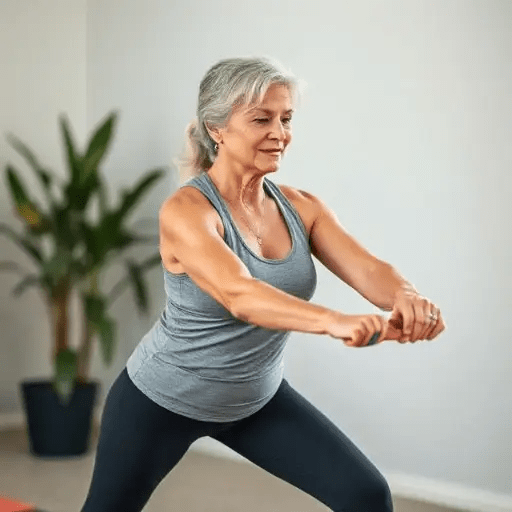
The first workout, which focuses on speed, involves doing exercises such as the sprinter step-back, power press-up, and paused squat jump. These exercises are designed to help you build controlled explosiveness and move with intent. To perform the sprinter step-back, stand tall with your feet hip-width apart, then step one foot back into a deep lunge, driving the opposite arm forward. Push through your front heel to drive back up to standing, and alternate sides.
The power press-up is another exercise that requires power to perform. To do it, start in a plank position with your hands shoulder-width apart, then lower your body down until your chest nearly touches the ground. From there, explosively push back up to the starting position, using your arms and legs to generate power.
The paused squat jump is a more advanced exercise that requires you to pause in a squat position for a brief moment before explosively jumping up. To perform this exercise, start in a squat position with your back straight and your knees behind your toes. Pause for a brief moment, then explosively jump up, landing softly on the balls of your feet.
The second workout, which focuses on reactive power, involves doing exercises such as forward scissors, high plank shoulder taps, and lateral pogos. These exercises are designed to help you build agility and power, and are perfect for improving your balance and coordination.
Forward scissors, for example, involve standing with your feet together, then quickly switching between a right and left foot movement, keeping your upper body steady. This exercise requires quick reactions and fast movements, making it an ideal way to build reactive power.
High plank shoulder taps involve holding a plank position with your hands shoulder-width apart, then quickly tapping one shoulder with the opposite hand. This exercise requires control and precision, making it a great way to build power and agility.
Lateral pogos, finally, involve bouncing from side to side, keeping your heels just off the ground and your upper body steady. This exercise requires quick reactions and fast movements, making it an ideal way to build reactive power and agility.
Incorporating these exercises into your routine can have a significant impact on your overall health and well-being. Not only can it help you build muscle power, but it can also improve your balance, coordination, and agility, reducing your risk of falls and injuries.
In addition to these benefits, building muscle power can also have a positive impact on your mental health. Exercise has been shown to reduce stress and anxiety, improve mood, and even help alleviate symptoms of depression.
So, if you’re looking to unlock a healthier and happier life, it’s time to focus on building muscle power. With these exercises and workouts, you can start building the strength and agility you need to stay active and confident well into your golden years.
Tips for Building Muscle Power
Start slowly and gradually increase the intensity and difficulty of your workouts
Focus on explosive movements, such as jumping and bounding
Incorporate plyometric exercises, such as box jumps and depth jumps
Try medicine ball throws and other dynamic movements
Incorporate agility drills, such as cone drills and ladder drills
Focus on building power in your lower body, particularly in your legs and glutes
Incorporate exercises that challenge your balance and coordination, such as single-leg squats and balance boards
Common Mistakes to Avoid
Not warming up properly before starting your workout
Not cooling down properly after finishing your workout
Not using proper form and technique when performing exercises
Not listening to your body and taking rest days when needed
Not challenging yourself enough and staying stuck in a rut
Not incorporating variety and change into your workout routine
Conclusion
Building muscle power is a key component of a healthy and happy life. By incorporating explosive movements and dynamic exercises into your routine, you can improve your balance, coordination, and agility, reducing your risk of falls and injuries. With these tips and workouts, you can start building the strength and agility you need to stay active and confident well into your golden years.




 The Tower Post